

More software does not automatically improve operations. If teams still reconcile records manually, route approvals through inboxes, or work around systems that ignore decision rights, another application may simply digitise the friction. Effective custom business software development starts earlier: with a validated operating process and a material constraint worth addressing.
Disconnected workflows make performance harder to see, while generic tools can force specialised work into controls that do not fit. These problems are real, but they do not automatically justify a bespoke system. The case depends on whether the operational requirement is clear, repeatable, and important enough to manage through software.
This guide explains how to assess that case and prepare a disciplined project. You will learn how to validate the process before defining features, translate requirements into controlled scope, and plan integrations, ownership, governance, adoption, and ongoing improvement. It also shows how business process management, digital forms, workflow automation, applications, and dashboards can support defined operations without turning a software initiative into an open-ended build. The objective is practical: encode what works, remove measurable friction, and give the system accountable owners.
Key Takeaways
- Identify whether recurring workarounds, fragmented information, or process constraints justify custom business software development.
- Use process evidence to define roles, decisions, hand-offs, and requirements before software design begins.
- Compare configuration, integration, and bespoke development against process fit, complexity, control, and ownership.
- Prepare for delivery by assigning process ownership, clarifying user needs and decision rights, and establishing baseline measures.
- Connect operational improvement with digital forms, workflow automation, applications, and dashboards to support defined processes.
When does custom business software solve an operational problem?
Custom business software is a digital system designed around an organisation’s specific requirements, operating processes, roles, and decision rules. Custom business software encodes validated operating requirements in a governed digital system. The distinction matters: bespoke technology should reflect a defined way of working, not simply reproduce every existing request in code.
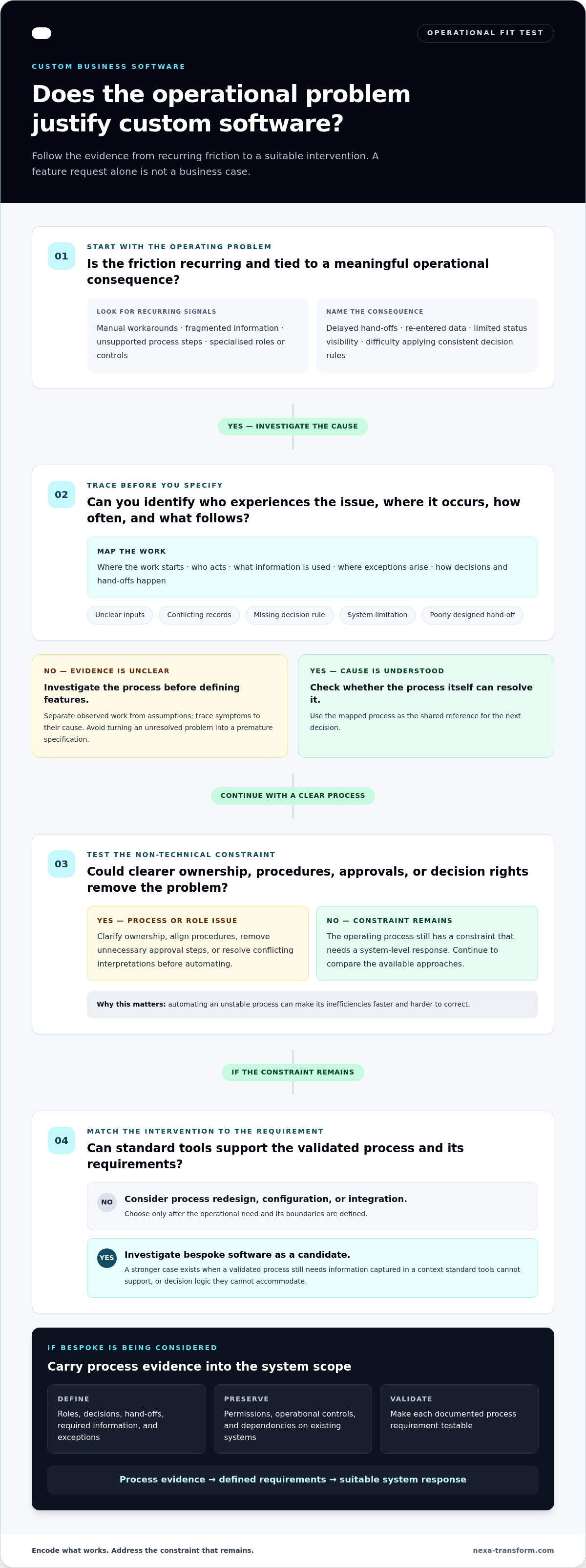
Investigate custom business software development when persistent operational friction points to a material constraint. Examples include recurring manual workarounds, fragmented information across systems, process steps that standard tools cannot support, or decision requirements tied to specialised roles and controls. A feature request alone is not a business case. Before setting the software scope, establish which process is affected, what the constraint causes, and whether the problem recurs.
Use a practical test: identify who experiences the issue, where and how often it occurs, and what operational consequence follows. That consequence might be delayed hand-offs, re-entered data, limited status visibility, or difficulty applying consistent decision rules. The answers help distinguish a persistent operating problem from a preference for a bespoke interface or a one-off exception.
Which operational signals justify investigating bespoke software?
Repeated manual hand-offs, duplicate data entry, and avoidable delays are useful discovery signals. Process defects, safety hazards, or poor visibility into work status can also warrant investigation. None proves on its own that new software is required. Trace each symptom through the process to locate its cause: unclear inputs, conflicting records, a missing decision rule, a system limitation, or a poorly designed hand-off.
Root-cause analysis helps prevent symptoms from becoming premature specifications. Map where the work starts, who acts, what information is used, and where exceptions arise. Methods such as 5-Why or Ishikawa analysis can structure the investigation. This discipline aligns with Software Engineering Principles: define the problem and constraints before translating them into system behaviour.
When is process change more important than new software?
Some constraints are organisational, not technical. Unclear ownership, inconsistent procedures, unnecessary approval steps, and conflicting interpretations of policy can persist after a new application is introduced. Automating an unstable process may make its inefficiencies faster and harder to correct.
Map the current workflow before setting application scope. BPMN 2.0 can make roles, events, decisions, and hand-offs explicit, helping teams identify duplicated checks or ambiguous accountability. Then agree on the intended process and decision rights. If clearer procedures or better role alignment resolve the issue, software may not be the first intervention.
Custom development becomes a stronger candidate when the validated process still faces a genuine system constraint, such as information that cannot be captured in the required context or decision logic that standard tools cannot accommodate. Treat process evidence as an entry criterion, not a formality. The response may be process redesign, system configuration, integration, or bespoke software. Select the intervention only after defining the operational need and its boundaries.
How custom business software moves from process evidence to system design
Process evidence becomes useful to a software project when each finding can be traced to a requirement, design decision, and validation method. A disciplined sequence keeps those links visible: investigate, map, specify, design, build, validate, deploy, and improve. Each stage produces information the next needs. Jumping from a reported problem straight to feature development leaves assumptions unresolved and makes scope harder to control.
BPMN 2.0 supports this transition by representing process roles, events, decisions, and hand-offs before application design. The model helps teams establish who performs each activity, what triggers it, where a decision is made, and how exceptions move through the workflow. It provides a shared reference for operational stakeholders and the technical team, but does not replace the need to agree on the process itself.
How process analysis shapes software requirements
Separate current-state evidence from the proposed future state. Interviews, observed work, existing forms, and workflow records can reveal what people actually do, including informal checks and exception paths. The future-state process defines the intended operating method. Keeping both views separate prevents current workarounds from becoming permanent system features by default.
Translate each validated process element into system implications. A hand-off may require a task assignment and status record; a controlled decision may require a rule, an authorised role, and a recorded outcome. Specify what information users need to enter or view, which permissions govern access, and what operational controls must be preserved. Requirements should distinguish essential behaviour from preferences and identify dependencies, such as data sources or interfaces with existing systems.
Turn every documented process requirement into a testable acceptance criterion. State the expected system behaviour and the conditions under which it must occur.
How design, testing, and deployment preserve operational intent
Before implementation, prototypes or design reviews can expose gaps in screen sequence, terminology, information visibility, and exception handling. Ask intended users and process owners to review realistic scenarios, not just isolated screens. Their feedback should resolve operational questions while changes are still easy to assess against the agreed scope.
Build validation around business rules, user roles, and representative end-to-end scenarios. For example, test a standard transaction, a rejected submission, and a case requiring escalation if those paths are part of the defined process. Confirm that access permissions and required records behave as specified. Log defects against the originating requirement so the team can distinguish a software fault from a disputed process decision.
Deployment also requires operational preparation. Assign an owner for system decisions and ongoing process changes, prepare users for revised tasks, and establish how support issues will be recorded and assessed. After launch, compare actual use and process indicators with the baseline, then prioritise improvements through governed change control. This keeps custom business software development connected to operating intent instead of letting it drift into an unowned feature backlog. Organisations aligning process analysis with system delivery can explore business process management and digital systems as a joined capability.
Custom software, configuration, or integration: how to frame the decision
Once requirements are defined, compare the available interventions against the same operating criteria. Configuration adjusts the capabilities of an existing system. Integration connects systems so they can exchange information across a workflow. Bespoke development creates a system around requirements existing capabilities cannot adequately support. None is inherently superior. The decision turns on process fit, required control, complexity, and the organisation’s capacity to own the result.
Configuration: Suitable when existing functions support the validated process with limited compromise. Assess whether settings can handle the required roles, rules, and information without creating cumbersome workarounds.
Integration: Suitable when established systems need controlled information exchange across defined steps. Assess data reliability, responsibilities at each hand-off, and how exceptions will be managed.
Bespoke development: Suitable when distinctive rules, roles, data relationships, or process dependencies cannot be accommodated without material compromise. Assess whether the organisation can govern requirements and ongoing system decisions.
This comparison is a decision aid, not a scoring exercise that automatically selects a winner. For example, if a team’s process is sound but information is isolated between applications, integration may address the constraint. If the workflow has unclear ownership or unnecessary approvals, connecting those systems could simply transmit the same confusion faster. Integration moves information; it does not validate the process or correct weak governance.
When should an organisation configure or integrate existing software?
Configuration is a sound candidate when an existing system can support the agreed requirements through settings, permissions, and available workflow controls while keeping process compromises acceptable. Integration fits when systems hold distinct information needed at defined points in the workflow. Document what each system provides, what information must move, who is accountable for it, and how staff should handle missing or conflicting data. This grounds the decision in operating needs rather than assumptions about technical convenience.
When does a bespoke system better fit the operating model?
Bespoke development merits assessment when the process depends on specialised decision rules, role boundaries, linked data, or dependencies that existing capabilities cannot support without undermining the validated workflow. Fit alone is not enough. Confirm that the organisation can assign owners for requirements, permissions, change decisions, user adoption, and ongoing improvement. Custom business software development creates an enduring operational asset, so governance and ownership belong in the decision alongside functional scope.
Compare options qualitatively across the full operating commitment: process compromise, control over change, integration complexity, maintenance responsibility, and internal capacity to govern. Do not treat the initial feature list as the total scope. A dedicated bespoke software versus SaaS comparison can examine purchasing considerations in greater detail; this decision framework focuses on matching the intervention to a validated operational need. Select the least complex option that preserves the required process controls and can be managed over time.
How to prepare your organisation for custom software development
Project readiness depends on more than a defined feature list. Before custom business software development begins, the organisation needs accountable process owners, operational input, reliable information, clear decision rights, and a way to evaluate whether the delivered system supports its requirements. Treat readiness as a governance task, not an administrative prelude.
What should the business define before development begins?
Name an accountable owner for each process in scope and involve representatives from the roles affected by the proposed system. Document priorities, exceptions, reporting needs, and dependencies between workflows. Set acceptance criteria that describe required system behaviour, alongside baseline measures that show current operating conditions. These measures provide a reference for later evaluation without predetermining the outcome.
- Process ownership: Identify who approves process rules, resolves conflicting requirements, and accepts changes.
- User groups: Record affected roles, their tasks, and the access each role needs.
- Data: Identify required information, its source, any quality issues, and who is responsible for maintaining it.
- Decision rights: Define approval authority, escalation paths, and how exceptions are handled.
- Operational constraints: Document relevant working conditions, dependencies, reporting needs, and integration points.
- Measures and acceptance: Capture current indicators, such as processing time, rework frequency, or incomplete submissions, where relevant and measurable. Agree on how required system behaviour will be tested.
These inputs connect process intent to delivery controls. Nexa’s process-led digital systems work brings operational requirements and system design into the same project conversation.
Readiness also means planning delivery workstreams rather than treating them as late-stage checks. Define access control and data-handling responsibilities, identify integrations and their information dependencies, prepare representative scenarios for testing, and plan user communication and change management. Assign an owner to each workstream and establish a route for resolving decisions. This structure limits ambiguity as project details develop.
How should teams govern adoption and ongoing improvement?
Before deployment, assign responsibility for user access, data quality, process changes, and operational decisions. Prepare users for changes to tasks and interfaces, establish how they can provide feedback, and define where questions or incidents should be escalated. Training should reflect actual roles and process scenarios, not just provide a feature tour.
After deployment, review use and process measures against the agreed baseline and acceptance criteria. Separate defects from requests for new functionality, then assess proposed changes against operational priorities, ownership, and scope. A controlled review cycle helps the organisation maintain the system as processes evolve without allowing ungoverned requests to displace the original business need.
How Nexa connects operational improvement with custom software development
Software scope is stronger when it follows process evidence. Nexa Transform Group combines bespoke digital systems engineering with business process management and operational improvement, connecting analysis of how work is performed to decisions about what a system should support. This grounds custom business software development in defined workflows and organisational requirements, rather than treating technology as a separate intervention.
For organisations in South African manufacturing, mining, the public sector, and private industry, process dependencies and operating conditions shape what a system needs to do. Workflow analysis can clarify where information passes between roles, where decisions occur, and where bottlenecks, defects, or hazards warrant investigation. The resulting evidence helps distinguish a system requirement from a process issue that needs a different response.
How operational methods inform digital system scope
The improvement method should fit the question being investigated. BPMN 2.0 can represent process activities, roles, events, and hand-offs. DMAIC can structure a defined improvement effort, while 5S may help examine workplace organisation. Ishikawa analysis and 5-Why methods can support root-cause investigation when defects or delays need explanation. No single project needs to use every method.
That analysis can establish which operational rules a system must represent, what information is needed at each step, and where responsibility or escalation must be clear. It can also show that a proposed digital feature would formalise an unverified practice. Keeping process findings traceable to requirements helps control scope and preserve operational intent through design and validation.
What a structured Nexa engagement can address
Once process requirements are understood, the system form should match the work. Nexa builds enterprise web applications, operational portals and back-office systems, mobile and field operations applications, digital forms, workflow automation, and dashboards. Each can support a defined operational purpose: forms can capture process information, automation can route specified work, applications can support operational tasks, and dashboards can present relevant measures.
Combining business process management and system engineering also supports alignment between process owners, users, and technical requirements. A project can address the workflow and its digital support together, keeping decisions about roles, information, and controls connected to the defined operating model. The objective is not to digitise every activity, but to shape a system around requirements the organisation understands and can govern.
Discuss your process objectives and digital system requirements with Nexa to define a process-led path from operational need to system scope. Discuss your business process or digital system requirement.
Move from operational need to a governed next step
The next step is not to commission features. It is to define the operating constraint clearly enough that leaders can decide what to change, what evidence will guide the decision, and who will own the system over time. That discipline keeps custom business software development tied to a real business requirement rather than technology for its own sake.
Nexa Transform Group brings operational consulting and bespoke software engineering together. Its process toolkit includes BPMN 2.0, DMAIC, 5S, Ishikawa analysis, and 5-Why methods, selected to support process diagnosis and inform system scope. The focus is practical: connect the operating model to digital requirements the organisation can govern.
Bring a defined workflow, constraint, or system requirement into the next discussion. Discuss your custom business software requirements with Nexa Transform Group and identify a disciplined path forward. Clear ownership and sound process evidence give the work a stronger foundation.
Frequently Asked Questions
What is custom business software development?
Custom business software development is the design and engineering of an application around an organisation’s specific operating needs, rather than relying solely on fixed, generic functions. It may support a single controlled activity or connect several roles through shared records. For example, a field inspection system could capture findings in context and route them according to internal decision rules. Its defining feature is alignment with defined requirements.
How much does custom business software development cost?
There is no universal cost because project scope varies. The effort depends on factors such as the number of user roles, required functions, data requirements, integrations, and testing needs. Ongoing maintenance and governance are also part of the ownership commitment. A useful first step is to separate essential operating requirements from optional enhancements, then define a bounded scope that can be assessed and prioritised.
How long does it take to develop custom business software?
Development time depends on the scope and complexity of the system, the clarity of requirements, the number of integrations, and how quickly stakeholders can make decisions and validate work. A focused internal tool differs substantially from a system supporting several departments and exception paths. Establish delivery stages and decision owners early, then plan time for user review, testing, deployment preparation, and any required process changes.
Is custom software better than off-the-shelf software?
Neither option is automatically better. The right choice depends on how closely available capabilities fit the validated process and how much control the organisation needs. Standard software may be sufficient for a common workflow with limited variations. A specialised operation with distinctive rules or data relationships may need a tailored approach. Compare process fit, configuration limits, integration needs, change ownership, and long-term governance before deciding.
Can custom business software integrate with existing systems?
Yes, custom systems can be designed to exchange information with existing applications when the requirements and connection points are defined. Start by identifying which system owns each data item, when information must move, and how errors or conflicting records will be handled. For example, an operational application might need to receive reference data from one system and return completed work records to another. Integration planning should include testing those exchanges.
What should a business prepare before starting a custom software project?
Prepare a concise project brief that names the accountable process owner, affected user groups, priority requirements, and the decisions the system must support. Include representative forms, sample records, exception cases, reporting needs, and known dependencies. Identify who can approve scope changes and who will coordinate user feedback. These materials give the project team concrete evidence to assess and expose unresolved questions before they become design assumptions.

