

An operational diagnosis that stops at recommendations leaves the constraint in place. Recurring bottlenecks, defects and safety hazards continue to consume capacity when operational improvement consulting does not connect evidence-led diagnosis with implementation, clear ownership and capability transfer.
Leaders need more than an improvement report. They need a defined mandate, relevant measures, clear governance and a practical route from identifying root causes to changing how work gets done. This guide explains how to assess consulting fit, define an engagement scope and evaluate delivery before committing to a programme.
It covers the practical questions behind implementation, from establishing an operational baseline and assigning owners to setting review measures and building workforce capability. It also explains how BPMN 2.0, 5S, DMAIC, Ishikawa (Fishbone 6M) and 5-Why can be selected to suit the issue and available evidence. Finally, it considers how process changes can connect with organisational development, skills development, workflow automation and bespoke digital systems to support consistent execution across South African operations.
Key Takeaways
- Use recurring bottlenecks, defects, safety hazards and inconsistent workflows as signals to distinguish isolated issues from problems that need structured diagnosis.
- Define the engagement around a clear mandate, process findings, prioritised actions, accountable owners and outcome measures.
- Compare operational improvement consulting approaches by their implementation responsibilities, workforce involvement, measurement discipline and digital enablement.
- Build a decision-ready brief by documenting the affected process, roles, operational evidence and a manageable scope.
- Match methods such as BPMN 2.0, 5S, DMAIC, Ishikawa and 5-Why to the issue, then connect process changes to capability development and relevant digital systems.
When operational improvement consulting is justified in South Africa
Persistent bottlenecks, recurring defects, safety hazards and inconsistent workflows warrant attention, particularly when local fixes have not lasted. The case for structured support depends on whether the issue is isolated or rooted in connected processes, roles and hand-offs. A single equipment fault may have a local cause. Repeated delays across planning, approvals and field execution are more likely to point to a broader process constraint that needs investigation.
Operational improvement consulting examines how work performs, addresses sources of operational friction and establishes measures to help sustain execution. It connects process design, people and systems, the core concerns of Operations Management Overview.
Signals that an operational improvement mandate is needed
A mandate is justified when the same problem returns after informal workarounds, or when resolving one issue shifts pressure elsewhere. Rework, for example, may stem from unclear specifications, incomplete information or inconsistent hand-offs rather than the point where a defect becomes visible. Treating each incident separately can hide the process conditions that cause it to recur.
Look for patterns such as:
- Work waiting between teams, approval stages or operational sites, with no clear owner responsible for resolving the delay.
- Defects or repeat tasks appearing at several points in a workflow despite local corrective actions.
- Safety concerns or inconsistent task execution connected to unclear procedures, role boundaries or information flow.
These signals are different from a general desire to modernise. A useful mandate names the affected process, the observable performance gap and the operational evidence available. Technology may form part of the response, but digitising a poorly understood workflow can preserve its delays and control weaknesses.
South African operating context and organisational fit
Operating conditions differ across manufacturing plants, mining operations, public organisations and private businesses. A production workflow may be constrained by sequencing, inspection or material hand-offs. A mining or field process may rely on coordination between site-based teams and support functions. Public and private organisations can also differ in decision rights, approval paths and service responsibilities. These are factors to investigate, not assumptions about every organisation in a sector.
Site structure matters as much as sector. Responsibilities, information practices or local operating risks can cause a process to work differently from one location to another. Define where the process begins and ends, which roles perform or control each step, and what evidence can reveal variation. This gives leaders a grounded way to compare current practices without assuming that one intervention will suit every site.
Nexa Transform Group works with private, public, manufacturing and mining organisations across all nine South African provinces and internationally. The starting point is the organisation’s actual workflow and evidence, not a standard prescription. Operational improvement consulting is most useful when the scope reflects local conditions, identifies accountable process owners and targets a recurring performance issue that leaders can measure and review.
What operational improvement consulting should deliver from diagnosis to implementation
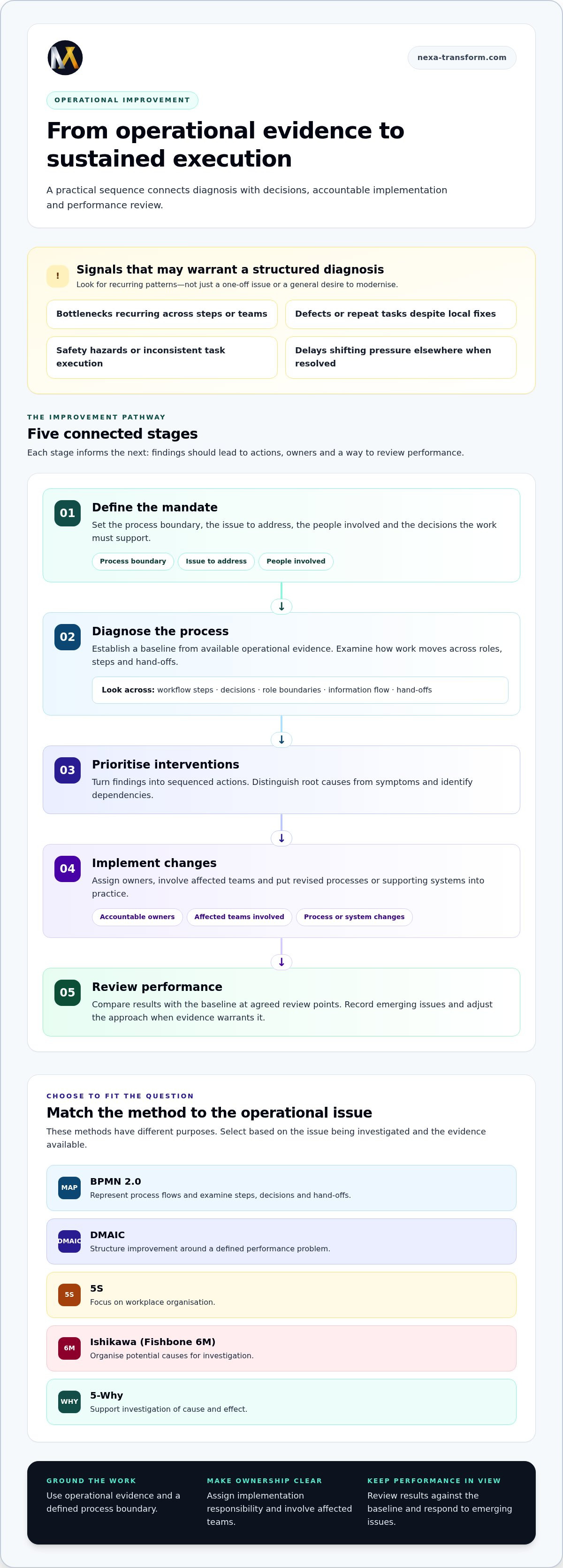
A sound engagement follows a defined progression, with each stage informing the next. Operational improvement consulting should not end with a diagnosis or a list of recommendations. It should connect evidence to decisions, assign implementation responsibility and establish how performance will be reviewed.
Effective improvement connects diagnosis to accountable implementation, then uses performance review to keep the changed process under control.
- Define the mandate. Set the process boundary, the issue to address, the people involved and the decisions the work must support.
- Diagnose the process. Establish a baseline from available operational evidence and examine how work moves across roles, steps and hand-offs.
- Prioritise interventions. Turn findings into sequenced actions, distinguish root causes from symptoms and identify dependencies.
- Implement changes. Assign owners, involve affected teams and put revised processes or supporting systems into practice.
- Review performance. Compare results with the baseline at agreed review points, record emerging issues and adjust the approach when the evidence warrants it.
Methods matched to the operational problem
Choose a method to fit the question being investigated. BPMN 2.0 provides a structured way to represent process flows and examine steps, decisions and hand-offs. DMAIC structures improvement around a defined performance problem. 5S focuses on workplace organisation. Ishikawa (Fishbone 6M) helps organise potential causes, while 5-Why supports investigation of cause and effect. These methods serve different purposes. Select one based on the issue and evidence, rather than applying a fixed template.
For example, unclear process ownership may call for mapping responsibilities and decision points, while recurring defects may need systematic cause analysis. A congested work area presents a different problem from repeated approval delays. The aim is to choose a method that sharpens diagnosis and informs an intervention, not to apply every framework to every engagement.
Deliverables and implementation governance
Useful outputs make the work actionable: a documented baseline, process findings, a prioritised action plan, named owners and defined outcome measures. Each action should link to a finding, so leaders can see why it is being undertaken and what evidence will inform its review. Measures should reflect the problem being investigated rather than assume a particular gain in advance.
Governance turns the plan into controlled execution. Review points give owners a forum to report progress, resolve dependencies and assess whether an intervention addresses the diagnosed cause. They also help distinguish implementation delays from a solution that needs adjustment. Keep accountability visible by clarifying responsibility for tasks, authority to make decisions and routes for escalating barriers.
Capability transfer is part of delivery, not an optional handover. Teams need to understand the revised process, their responsibilities and how to use the measures that monitor it. When the intervention calls for digital support, workflow automation, digital forms or a custom system can support the redesigned process. Nexa Transform Group's process improvement and BPM consulting connects diagnosis with implementation planning, workforce capability and relevant digital systems.
How to compare operational improvement consulting approaches
Compare the engagement design, not only the proposed methods or final report. A recommendation-only scope can clarify causes and options, but the organisation retains responsibility for implementation. An engagement that includes implementation support and review connects diagnosis to execution, while operational leaders remain accountable for decisions and results.
Use the comparison below to clarify what each scope covers. These are engagement types, not a ranking of providers.
| Scope area | Recommendation-only scope | Implementation support and review |
|---|---|---|
| Diagnosis | Maps the process, reviews evidence and presents findings or proposed actions. | Establishes findings and supports validation as changes are put into practice. |
| Implementation responsibility | Client leaders assign owners and coordinate execution after recommendations are delivered. | Consultant and client responsibilities are defined for action planning, coordination and review; operational accountability remains visible. |
| Workforce involvement | Team input may inform diagnosis, with adoption managed internally. | Relevant leaders and frontline roles contribute to testing changes and identifying implementation barriers. |
| Measurement | Findings and proposed measures may be handed over for internal monitoring. | Baseline measures and review points are used to assess implementation and inform adjustments. |
| Digital enablement | Technology options may be identified for later assessment. | Workflow automation or custom systems can support an agreed process design where there is a defined need. |
Consulting scope, ownership, and execution support
Clarify who maps the process, prioritises interventions, coordinates implementation and resolves cross-functional dependencies. Specify how operational leaders and frontline teams contribute. Leaders provide decision authority, while the people doing the work can reveal process variation that formal documentation may miss. Named owners, review forums and escalation paths make responsibility actionable rather than assumed.
Measures, capability transfer, and digital fit
Agree how the current process will be assessed and when progress will be reviewed before work begins. Measures should relate to the stated operational issue, without assuming a target improvement. Assess how teams will learn and maintain revised procedures so ownership stays within the organisation. Automation or bespoke digital systems are a fit when they address a defined process need, not when they substitute for diagnosing the workflow.
Operational improvement consulting is easier to assess when the hand-off from analysis to execution is explicit. Check that every proposed intervention has a rationale, an owner, a way to review progress and a clear link to the process problem. This helps leaders distinguish a useful diagnostic product from a delivery model designed to support implementation and organisational capability.
How to define a decision-ready operational improvement brief
A decision-ready brief turns a broad concern into a bounded assignment. It gives operational improvement consulting a clear starting point: the issue to investigate, the process and people in scope, the evidence available and the authority to act on findings. Make the brief specific enough to guide diagnosis, but open enough to test assumptions about causes.
Document the mandate in sequence:
- State the issue. Describe the recurring delay, defect, safety concern or operational variation. Separate observed effects from suspected causes.
- Set the process boundary. Identify where the workflow begins and ends, including relevant hand-offs, sites or business units.
- Name affected roles. Record who performs, supervises, approves or depends on the work, and identify decision owners.
- Gather evidence. Assemble available workflow records, defect or safety reports, performance measures, and examples of rework or delay.
- Define the review basis. Select baseline indicators linked to the issue and set a review cadence before choosing interventions.
Scope the problem and establish a baseline
Choose a manageable boundary, such as one site, workflow, problem category or accountable business unit. A brief focused on a specific hand-off or recurring defect is easier to investigate than a mandate to modernise an entire operation. Record the period and source for each available measure, note gaps in the evidence, and identify constraints or dependencies that could affect the work.
| Readiness evidence | Assumption requiring validation |
|---|---|
| A defined process boundary, with start and end points | The issue has the same cause across every site or team |
| Available records or observations tied to the stated problem | Reported delays or defects have a single root cause |
| Named affected roles and operational decision owners | One department can resolve a cross-functional constraint alone |
| Baseline indicators and proposed review cadence | A preferred solution will improve the selected measures |
| Known constraints, dependencies and evidence gaps | Automation is necessary before the process is understood |
Set governance and change-readiness conditions
Assign an executive sponsor to resolve priorities, an operational owner to coordinate the process, and frontline participants to contribute practical knowledge. Define who can approve changes, how progress will be reviewed and what evidence would trigger an adjustment. Note whether skills development or digital implementation may support the change, without assuming either is required.
Before issuing the brief, confirm that the problem is observable, the scope is bounded, and the organisation can provide access to relevant roles and evidence. Nexa Transform’s process improvement services can help frame a mandate around your process, evidence and implementation needs.
How Nexa Transform connects operational diagnosis with sustained execution
A defined problem, bounded process and decision-ready brief create a basis for action. Nexa Transform Group connects operational improvement consulting with business process management, selecting methods according to the evidence and issue rather than applying a single framework to every mandate. The work can extend from process diagnosis into implementation support, organisational capability and relevant digital enablement.
Nexa’s methods and operational improvement capabilities
Each method provides a different lens. BPMN 2.0 represents process flows so steps, decisions and hand-offs can be examined. DMAIC structures improvement around a defined problem. 5S addresses workplace organisation. Ishikawa (Fishbone 6M) organises potential causes, while 5-Why supports investigation of cause and effect. The operational issue guides the selection:
- For bottlenecks, process mapping can expose delays and dependencies across workflow stages.
- For recurring defects, cause-analysis methods can structure investigation beyond the point where the fault appears.
- For safety hazards or inconsistent work practices, workplace organisation and examination of process conditions can inform interventions.
These are not automatic prescriptions. A method is useful when it answers a specific diagnostic question and informs a practical intervention. Nexa works with private, public, manufacturing and mining organisations across all nine South African provinces and internationally. That operating context informs the work, while each organisation’s process, roles and risks shape the engagement.
From engagement scope to next steps
A strong starting brief identifies the recurring problem, process boundary, affected stakeholders, available evidence and measures for assessing performance. Nexa aligns business process management and improvement work with accountable ownership and review. The result is a structured route from the operational issue to proposed changes, rather than a generic recommendation detached from the conditions in which work is performed.
Execution may also depend on organisational capability. Organisational development and skills development can support role clarity and adoption of changed processes. When the agreed process needs digital support, workflow automation, digital forms or bespoke systems can help put the design into practice. The connection depends on the diagnosed need. Technology should support the process, not replace its analysis.
For leaders preparing a mandate, align the scope, evidence, decision rights and intended measures with the operational challenge. Nexa Transform’s operational improvement consulting connects process diagnosis with implementation needs.
Put the next improvement mandate into motion
Turn an operational concern into a decision leaders can act on: define the process boundary, identify who can make changes and agree what evidence will guide the work. This discipline gives operational improvement consulting a clear purpose and keeps proposed interventions connected to operational priorities.
Nexa Transform applies BPMN 2.0, DMAIC and 5S in its work with private, public, manufacturing and mining organisations across South Africa’s nine provinces. Methods and engagement scope are shaped around the operational issue, with relevant organisational development, skills development or digital implementation connected where they support execution.
Bring the process concern, available evidence and intended measures into a discussion with Nexa Transform. Discuss your operational improvement requirements with Nexa Transform and take a structured next step toward more controlled execution.
Frequently Asked Questions
What does operational improvement consulting include?
Operational improvement consulting examines how work is performed, identifies process constraints and supports changes intended to address them. Diagnosis establishes what is happening and where; implementation support helps translate findings into revised practices, responsibilities or systems. Review examines evidence from the changed operation and informs further action. The scope can focus on analysis or extend through implementation, depending on the organisation’s needs and internal capacity.
How do I know if my organisation needs operational improvement consulting?
Consider structured diagnosis when the same delays, defects or workarounds persist despite local corrective action, particularly when the issue crosses team boundaries. An approval queue, for example, may look like one manager’s backlog but stem from incomplete submissions or unclear hand-offs upstream. If teams describe the workflow differently, or leaders cannot identify who owns the constraint, a systematic review can clarify where to focus investigation.
How long does an operational improvement consulting engagement take?
Duration depends on the mandate’s scope, process complexity, access to relevant evidence and people, and whether the work includes implementation and review. A contained workflow with accessible records differs from a multi-site process involving several decision points and teams. Review requirements also matter: a recommendation handover and a period of supported implementation involve different work. Define these boundaries early so the engagement plan reflects the actual assignment.
What methods do operational improvement consultants use?
Methods are selected to fit the diagnostic question. BPMN 2.0 represents process flows, making steps and hand-offs visible. DMAIC structures work around a defined improvement problem, while 5S focuses on workplace organisation. Ishikawa, or Fishbone 6M, helps organise possible causes, while 5-Why explores cause and effect. These approaches are distinct, not interchangeable checklists. A consultant can select one or combine methods when the process evidence and issue justify it.
Can operational improvement consulting address safety hazards and recurring defects?
Yes. Consulting can examine how work design, task sequence, information flow, hand-offs or role clarity relate to reported hazards and repeated defects. The analysis can help distinguish an isolated event from a process pattern and inform intervention planning. Changes should be assessed against the organisation’s operating conditions and relevant controls. Consulting can support investigation and improvement planning, but no method alone guarantees that hazards or defects will be eliminated.
How can I measure whether operational improvement consulting is working?
Compare agreed indicators with a documented baseline, using evidence that relates directly to the problem. For a delay issue, this could include queue age or time spent between process stages. For quality, repeat defect counts or first-pass completion may be relevant. Assign owners to collect and review the measures, and set a consistent review cadence. Interpret results alongside operational context, since changes in workload or process conditions can affect the evidence.
Can operational improvement consulting include workflow automation or custom software?
Yes. Digital implementation can support a process once its needs and design have been analysed. Workflow automation may suit a defined approval or information-routing step; a custom digital system may support requirements that call for a tailored operational application. Technology should reinforce agreed responsibilities and process controls, not simply reproduce unnecessary steps. Bespoke system development is distinct from a standalone, off-the-shelf software subscription.

