

A recurring defect is a signal, not a diagnosis. DMAIC process improvement gives teams a disciplined way to trace that signal to a verified cause before committing resources to a fix. When bottlenecks persist or safety hazards return, the pressure to act quickly is understandable. But a solution based on assumption can leave the underlying process unchanged.
This guide explains how to run a DMAIC project with evidence at every phase. You’ll learn how to define a measurable problem, establish a reliable baseline, analyze potential causes, test targeted improvements, and control the process so verified gains hold. Each phase has a clear purpose and practical outputs, from a focused problem statement to routine performance monitoring. The result is a structured way to improve an existing process without turning DMAIC into a paperwork exercise.
Key Takeaways
- Use DMAIC process improvement to strengthen an existing process. Use a different approach when the goal is to design a fundamentally new process or service.
- Build a reliable starting point by agreeing on scope, operational definitions, a data plan, and a baseline. Use SIPOC to map the process at a high level.
- Test possible root causes against process evidence, then stratify data to identify patterns across shifts, locations, products, or time periods.
- Assess countermeasures, pilot changes, and compare results with the baseline before standardising work and monitoring performance.
- Apply DMAIC to bottlenecks, defects, workflow performance, and safety hazards. Use BPMN 2.0 to clarify process context where it adds value.
DMAIC process improvement: When the method fits an operational problem
DMAIC is a five-phase method for improving an existing process through evidence-led decisions: Define the problem, Measure current performance, Analyze causes, Improve the process, and Control the gains. Each phase produces evidence that informs the next, so teams don’t jump from a visible symptom to a preferred fix. For an overview of its phases and Six Sigma context, see the DMAIC methodology on Wikipedia.
DMAIC is a governed improvement method that moves a scoped, measurable process problem from a verified baseline to tested countermeasures and sustained control. That distinguishes DMAIC process improvement from an informal sequence of improvement activities. A workshop may generate ideas; DMAIC requires a defined problem, reliable measurement, analysis of causes, and evidence that a change works.
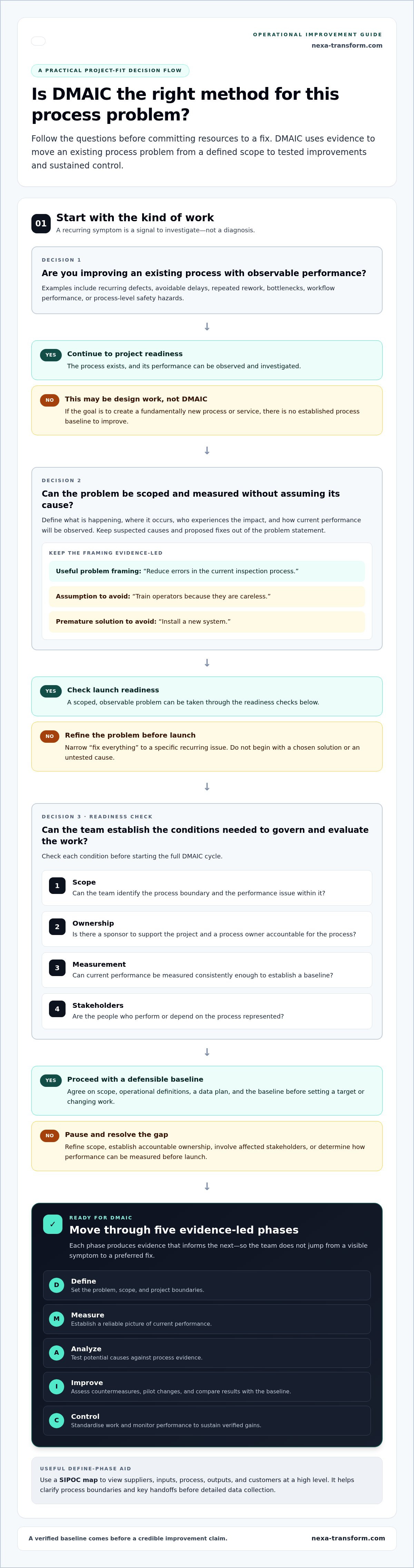
The method fits an existing operation with observable performance. If the objective is to create a fundamentally new service or process, the work is design, not improvement of an established baseline. DMAIC is most useful when the issue recurs, the process boundary can be defined, a sponsor can support decisions, and an outcome can be measured. These conditions make the work governable without assuming the cause in advance.
What problems are suitable for DMAIC?
Recurring defects, avoidable delays, repeated rework, and process-level safety hazards can all warrant investigation. For example, a team may find that orders are often delayed between approval and dispatch. That observation is a symptom to define and measure, not proof that approvals are the cause. Focus on the existing workflow and its observable performance, then test possible explanations against process evidence.
Keep the problem statement separate from suspected causes and proposed solutions. “Reduce errors in the current inspection process” identifies an issue to investigate. “Train operators because they are careless” presumes a cause; “install a new system” prescribes a fix. Either assumption can distort the analysis before the team has established what is happening and where.
Check project readiness before launching
Before formal launch, specify where the process begins and ends, name the sponsor and process owner, and identify stakeholders affected by the work. Confirm who can provide data and who has authority to support changes. Establish a usable baseline before setting an improvement target; otherwise, the team cannot reliably judge whether performance changed.
- Scope: Can the team identify the process boundary and the performance issue within it?
- Ownership: Is there a sponsor to support the project and an owner accountable for the process?
- Measurement: Can the current condition be measured consistently enough to establish a baseline?
- Stakeholders: Are the people who perform or depend on the process represented?
If the project is framed as “fix everything,” begins with a chosen solution, or lacks an accountable owner, refine it before starting the full DMAIC cycle. Narrow the scope to a specific recurring issue and establish how performance will be observed. This readiness check helps prevent a project from starting with activity but no testable problem, decision authority, or basis for evaluating results.
Define and Measure: Establish the DMAIC baseline before changing work
Define and Measure turn an operational issue into a testable project. The sequence is deliberate: approve a charter, set scope, define measures, plan data collection, then establish the baseline. A SIPOC map clarifies suppliers, inputs, process, outputs, and customers at a high level. It helps the team see process boundaries and key handoffs before collecting detailed data.
An operationally defined baseline is the reference point that makes any later improvement claim testable. Without agreed definitions and a credible picture of current performance, teams can mistake inconsistent recording or normal variation for a real change.
Define the problem, scope, and customer requirement
Write the problem statement around observable facts: where the issue occurs, which process is affected, who experiences the impact, and what performance has been observed. For example, specify that completed work is returned for correction at a particular stage, rather than asserting that staff training is the cause. Keep suspected causes and preferred solutions out of the statement.
The charter should document the objective, boundaries, exclusions, sponsor, process owner, project roles, and stakeholders. Translate stakeholder needs into critical-to-quality (CTQ) requirements: measurable expectations that describe acceptable process performance. Set a target only when the available evidence supports it. A target without a defensible starting point is an aspiration, not a useful project control.
Measure current performance with a credible baseline
Operational definitions specify exactly what counts as an event and how it is recorded. Define terms such as “defect,” “late,” or “rework” so two observers examining the same case classify it consistently. Then document the data source, collection method, period covered, frequency, and accountable owner. Check whether records are complete and comparable across the project scope. Note missing fields, reliance on manual judgement, or changes in recording practice that could distort interpretation.
Select measures that show both results and process behaviour. An outcome measure tracks the result that matters, such as the proportion of completed items requiring correction. A process measure tracks activity linked to that result, such as the share of items passing a defined review step. A balancing measure checks whether an apparent gain creates a cost elsewhere, such as faster processing accompanied by more downstream rework. Use measures relevant to the project and make their calculation rules explicit.
Before interpreting variation, examine the measurement system itself. If observers apply different criteria or source records omit cases, apparent patterns may reflect data quality rather than process performance. Resolve practical weaknesses where possible and document any remaining limitations. This gives the Analyze phase a baseline for testing causes instead of conclusions built on uncertain inputs.
Teams building internal capability can explore DMAIC skills development to support consistent project practice.
Analyze: Find and verify the causes behind process performance
Analyze turns the baseline into a tested explanation of process performance. The team generates candidate causes, then checks them against evidence. A cause that sounds plausible or has been repeated for years is still a hypothesis until data supports it. This distinction keeps DMAIC process improvement focused on changing the conditions driving defects, delays, rework, or hazards, rather than treating visible symptoms.
A suspected cause is a proposition to test; a verified cause is one that process evidence supports as contributing to the observed effect. Analysis should separate tools that help generate explanations from methods used to validate them. A diagram can organise thinking, but it cannot establish causation by itself.
Generate candidate causes systematically
An Ishikawa diagram helps a team sort possible contributors into categories such as people, methods, equipment, materials, and environment. Use it to make assumptions visible, not to vote on which explanation is true. Then apply 5-Why questioning to a specific, observed failure chain. Each “why” should lead to a testable statement grounded in what happened, not a general judgement about people or performance.
Involve frontline employees and process experts. They can identify handoffs, informal workarounds, and operating conditions that records may not capture. Document each candidate cause, the observation supporting it, and the evidence that would confirm or weaken it. This creates a disciplined analysis register instead of an unranked list of opinions.
Validate causes against process data
Return to the baseline and examine how performance varies across relevant conditions. Stratify the data by time, location, product, equipment, or shift when those dimensions are within scope and recorded consistently. If rework clusters around one handoff or operating condition, that pattern can guide further investigation. If the rate is similar across groups, a theory focused on only one group has less support.
Patterns are clues, not automatic proof. Check whether the proposed cause occurs before the effect and whether it plausibly explains the type and distribution of failures observed. Where data allows, compare cases with and without the suspected condition, inspect records or observe the process, and seek corroborating evidence from people close to the work. A relationship in the data may justify a closer test, but it does not establish cause by itself.
Prioritise causes that have credible evidence and can be influenced within the project’s agreed boundary. Use this sequence:
- Specify the candidate cause and the expected process effect.
- Identify the data or observation that could test the relationship.
- Compare relevant cases or process conditions against the prediction.
- Record whether evidence supports, weakens, or leaves the cause unresolved.
Carry verified causes and remaining uncertainties into Improve. If evidence is weak, refine the measurement or continue the analysis rather than presenting an assumption as a finding. This handoff gives countermeasure design a defensible basis and keeps project decisions traceable.
Improve and Control: Test changes, confirm results, and sustain performance
Verified causes give the team a basis for action, not a guarantee that a proposed fix will work. Improve tests countermeasures against process evidence; Control transfers effective changes into routine operations with clear ownership and monitoring. Each tool should support a decision: risk assessment informs whether a test is appropriate, a pilot tests implementation, and monitoring signals when performance needs attention. This keeps DMAIC process improvement focused on operational impact rather than paperwork.
Improve through controlled testing
Design countermeasures to address verified causes and respect real process constraints. Assess potential risks before implementation, including unintended effects on quality, workload, safety, or downstream steps. Where practical, use a pilot or staged rollout to limit disruption and identify training, workflow, or resource issues before broader adoption.
Compare post-change results with the baseline using the same operational definitions and comparable data. Review outcome, process, and relevant balancing measures together. A favourable pilot result is evidence to assess, not proof that gains will persist under different conditions or at wider scale. If performance doesn’t improve as expected, investigate the result and adapt the countermeasure rather than declaring success.
Control the process after the project closes
Before handover, document the revised method, process owner, training requirements, monitoring approach, and escalation route. Set the review frequency and define response thresholds in advance, so the owner knows what signal requires investigation and who must act. Choose a control chart when the data and process support its use; otherwise, use a suitable monitoring method that makes drift visible.
Control is operational governance, not an administrative appendix. A monitoring measure should connect to an owner and a defined response. For example, if a defect measure crosses an agreed threshold, the process owner can verify the data, assess affected work, and escalate recurring or unresolved issues through the agreed route. Record the response and review whether the change remains effective.
Use this handover sequence to make each control actionable:
- Standardise: Update the work method and communicate what has changed.
- Assign: Name the owner responsible for routine monitoring and corrective action.
- Trigger: Define the performance signal that prompts review or escalation.
- Review: Set a practical cadence for checking results and control effectiveness.
To avoid turning DMAIC into bureaucracy, retain only the records, measures, and reviews that guide a decision, manage risk, or sustain performance. Nexa Transform Group supports structured improvement and project controls through its DMAIC improvement services.
Apply DMAIC across operations with Nexa Transform Group
DMAIC gives organisations a consistent structure for investigating operational problems across different environments, from manufacturing and mining to public and private services. A bottleneck, recurring defect, workflow delay, or process-level safety hazard can each become a specific improvement project, provided the team can define the process and assess performance. The method doesn’t prescribe one universal fix; it disciplines how teams move from an operational concern to evidence, action, and control.
Connect DMAIC to the wider process-improvement system
DMAIC can work alongside Lean methods and root-cause analysis, but each has a distinct role. DMAIC governs the improvement project from problem definition through control. Lean methods can help identify or reduce process waste, while tools such as Ishikawa and 5-Why support cause generation and investigation. Use methods where they serve a clear project decision rather than launching several frameworks at once and diluting accountability.
When a problem crosses roles or departments, BPMN 2.0 can make the workflow and its handoffs visible. A process diagram provides context about sequence, responsibilities, and information flow; it doesn’t replace Define’s work of setting the project boundary, exclusions, and measurable problem. Keep that distinction clear. The team can map the broader flow to understand a handoff, then scope the DMAIC project around the specific performance issue it will investigate.
For example, a delay may span request submission, review, and approval. A BPMN 2.0 model can show where those activities connect, while the DMAIC charter identifies which segment and outcome the project will address. That keeps the work anchored to one measurable problem instead of expanding into a general redesign of the whole operation.
Build internal capability and execution discipline
Reliable execution depends on distinct responsibilities. Leaders sponsor the work, align it with operational priorities, and support decisions when barriers arise. Process owners provide process knowledge and take responsibility for sustaining agreed changes. Team members contribute direct knowledge of how work is performed, help interpret evidence, and apply standardised practices. Clear roles reduce the risk of a project becoming detached from daily operations.
Nexa Transform Group provides operational improvement and business process management consulting, using root-cause approaches such as Ishikawa and 5-Why. Its online DMAIC skills development programmes can help organisations build internal capability. These options suit teams that need structured project support or employees who want a stronger working grasp of the method to contribute consistently across phases.
Effective DMAIC process improvement connects method to operational ownership: a defined problem, evidence-based decisions, and controls that remain part of routine work. Explore Nexa Transform Group’s operational improvement support to strengthen disciplined improvement across your organisation.
Turn your next operational priority into disciplined action
Start by selecting one operational issue that matters to performance and giving it the conditions for a sound investigation: leadership attention, a defined owner, and access to useful evidence. That decision sets the standard for DMAIC process improvement. The method creates value when teams use it to make better operational decisions, not simply to complete a sequence of project documents.
Execution also depends on capability. Nexa Transform Group combines operational improvement consulting with DMAIC skills development, supporting organisations as they build a consistent approach to improvement. Its consulting practice uses methods including DMAIC, Ishikawa, 5-Why, 5S, and BPMN 2.0, applying each where it supports the work rather than treating tools as ends in themselves.
Set a clear priority, align the people accountable for the process, and commit to acting on what the evidence shows. Explore Nexa Transform Group’s operational improvement support to identify a practical path for your organisation. With focused ownership and disciplined follow-through, recurring problems can become opportunities to strengthen how work is done.
Frequently Asked Questions
Is DMAIC only used in Six Sigma?
No. DMAIC is closely associated with Six Sigma, but organisations can use it as a structured method for improving existing processes outside a formal Six Sigma programme. Its value comes from disciplined problem definition, measurement, analysis, testing, and control, not from requiring a particular certification or organisational label. Teams can use DMAIC process improvement alongside business process management or Lean initiatives when a project needs a measurable, evidence-led approach.
Can DMAIC be used in service operations as well as manufacturing?
Yes. DMAIC applies wherever an existing process produces observable results, including services, administration, and customer support. A service team might investigate repeated errors in account setup, missed handoffs in a claims process, or long waits between request and resolution. Measures should reflect the operation, such as first-time completion, elapsed time, or repeat contacts, with definitions that account for variation in case complexity.
How long does a DMAIC project take?
There is no fixed duration. Timing depends on the project’s scope, how frequently the process runs, the availability and quality of data, and how much coordination a test requires. A narrow workflow with accessible records may progress differently from a cross-functional operation with infrequent events. Estimate the work phase by phase, including time to collect representative evidence, review pilot results, and transfer controls to the process owner.
What data is needed to start a DMAIC project?
Start with data that describes the problem in terms the team can apply consistently. For a service delay, that could include request and completion timestamps, case type, and current status. For a defect, capture the defect category, affected process step, and relevant operating conditions. You don’t need perfect data to begin, but you do need to assess whether records are available, comparable, and detailed enough to guide measurement.
When should an organisation use DMADV instead of DMAIC?
Use DMADV when the objective is to design a new product, service, or process, rather than improve one that already operates. For example, creating a new customer onboarding process calls for design requirements and validation of the new flow. If an onboarding process exists and the goal is to reduce errors or delays within it, DMAIC is generally the better fit. The distinction is the starting point: new design versus existing performance.
Can DMAIC help address recurring workplace safety hazards?
Yes. DMAIC can help investigate recurring hazards by examining where and under what operating conditions they arise, then testing whether process changes reduce exposure. For example, a team could study repeated trip hazards around a defined work area and assess contributing workflow or housekeeping conditions. DMAIC does not replace immediate risk controls or established safety responsibilities. Address urgent danger promptly while using structured analysis to prevent recurrence.

