

A recurring failure is rarely resolved by treating only its latest symptom. Root cause analysis consulting provides structured support to identify the factors behind a problem and turn findings into corrective actions designed to prevent recurrence. The focus is not just on what failed, but on the conditions that allowed it to happen.
That distinction matters to leaders because performance problems can have several interacting causes. A gap may stem from workflow design, systems, management support, incentives, or capability. A training fix or process reminder may not address what is actually blocking performance.
This article explains root cause analysis, how it supports continuous improvement, and how leaders can move corrective actions toward implementation. It covers common investigative methods, the role of evidence and team accountability, and factors that shape consulting support. The aim is practical: clearer diagnosis, actions matched to causes, and a disciplined path from analysis to operational change.
Key Takeaways
- Define the problem’s scope and impact before causes are investigated, so evidence gathering stays focused on the performance gap.
- Use structured methods such as 5 Whys, Fishbone analysis, and DMAIC to examine contributing factors from multiple angles.
- Translate verified causes into corrective actions with clear ownership, progress monitoring, and follow-through.
- Assess workflow, systems, management support, and incentives before treating a performance issue as a training gap.
- Build investigation findings into continuous improvement by connecting operational changes to measurable objectives and ongoing review.
What Is Root Cause Analysis?
Root cause analysis is a structured investigation used to identify the fundamental factors behind a failure, so corrective action can be directed at causes rather than symptoms. Methods such as 5 Whys can be used to examine the problem, evidence, and operational impact before changes are selected.
In the United States, the cost of root cause analysis consulting depends on scope, complexity, data availability, and implementation support. A price is provided after a quote request.
Investigation Scoping and Problem Definition
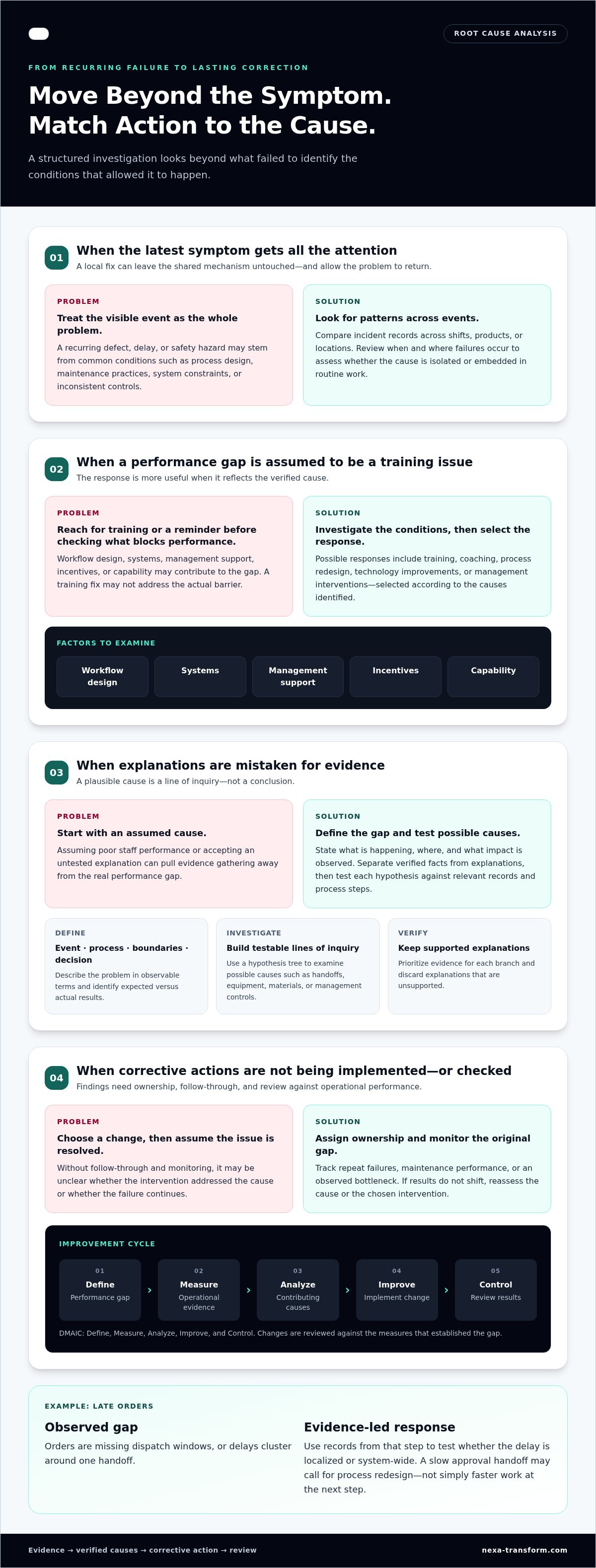
Scope an investigation by defining the event, affected process, review boundaries, and decision required. State the problem in observable terms, such as orders missing dispatch windows, rather than assuming a cause such as poor staff performance. This keeps evidence collection focused on the performance gap. Identify relevant records, stakeholders, and process steps, and document exclusions. If evidence crosses a boundary, revise the scope before reaching conclusions. Establish expected and actual results to describe the gap precisely.
Problem Statements and Hypothesis Trees
A problem statement anchors the investigation by describing what is happening, where, and what impact is observed. Separate verified facts from untested explanations. A hypothesis tree breaks the issue into possible causes, such as process handoffs, equipment condition, materials, or management controls. Treat each branch as a testable line of inquiry, not a conclusion. Prioritize evidence for each branch and discard unsupported explanations. For example, if late orders cluster around one handoff, use records from that step to test whether the delay is localized or system-wide.
Recurring Problems and Systemic Causes
When a defect, delay, or safety hazard returns after a local fix, look beyond the latest incident. Repeated events can point to shared conditions, including process design, maintenance practices, system constraints, or inconsistent controls. Compare incident records across shifts, products, or locations to identify patterns. A corrective change aimed only at the visible event may leave the common mechanism untouched, allowing the problem to recur. Reviewing when and where failures occur can show whether a cause is isolated or embedded in routine work.
8D Problem-Solving Methodology
Ford Motor Company developed the problem-solving methodology later known as 8D in the 1980s. It is organized around eight disciplines, or eight critical steps, for investigating and solving problems. The method is designed to identify a root cause, provide a short-term fix, and implement a long-term solution to prevent recurrence. Its disciplined structure supports clear problem definition, cause analysis, and corrective action. Documented findings should be used to assess whether proposed changes address the cause, rather than only contain immediate effects.
Continuous improvement
Root cause analysis supports continuous improvement by turning investigated failures into changes that can be assessed and refined. Its value depends on monitoring those changes against operational performance.
Operational Efficiency and Process Improvement
Lean techniques help identify bottlenecks and inefficiencies across a process. Workflow observation can reveal friction points, system challenges, and rework that interviews or surveys may miss. Once a delay is located, compare current performance with the desired result and examine the barriers contributing to the gap. For example, a slow approval handoff may call for process redesign, rather than faster work at the next step.
Continuous Improvement and Monitoring
Monitor changes against the problem identified during the investigation. Track repeat failures, maintenance performance, or an observed bottleneck to assess whether the intervention is working. If results do not shift, reassess the cause or chosen intervention. Historical trends and condition monitoring can also inform predictive maintenance, helping identify failure patterns and make interventions before breakdowns occur.
RCA History and Continuous Improvement
Six Sigma’s DMAIC process provides a structured improvement cycle: Define, Measure, Analyze, Improve, and Control. It is described as a statistical-based methodology for identifying root causes, with measurement and control supporting review after changes are introduced. The A3 report was first used by Toyota and applies Plan, Do, Check, Act. Problem identification, analysis, and resolution can be recorded on one sheet of paper, supporting concise progress reviews and decisions about next steps.
Product development can also benefit from examining market failures, customer feedback, and technological challenges together. These factors can guide innovation decisions instead of leaving teams to respond to individual complaints in isolation. For example, compare repeated customer reports about product performance with technical findings. The evidence can help determine whether a design adjustment or another development change is needed.
A practical improvement cycle starts with a selected performance gap, then tests contributing causes against operational evidence. Implement an intervention and review its effect using the same measures that established the gap. If workflow observation identifies duplicated data entry, redesign the step and assess whether process friction decreases. Use monitoring findings to inform the next improvement effort, keeping changes connected to observed results.
Workplace performance gaps may call for training, coaching, process redesign, technology improvements, or management interventions. Select the response according to the causes identified, rather than assuming every gap reflects a skills deficit. For instance, if employees know the procedure but an inefficient system blocks completion, system changes may be more relevant than additional instruction. This alignment helps target the factors affecting performance.
Can RCA consulting help with corrective actions that aren't getting implemented?
Root cause analysis consulting can help when approved corrective actions stall, ownership is unclear, or the same failure continues. Support can include evidence review, action development, implementation planning, and progress monitoring.
Consider a consultant when causes cannot be verified internally, decision-makers are not aligned, or corrective work is not progressing. Match the support to the problem’s complexity, available resources, and implementation barriers.
Corrective Action Development and Follow-Through
Link corrective actions to verified causes, with an owner, required resources, and a defined progress measure. For example, if a maintenance process contributes to the problem, address that process rather than merely recording the latest breakdown. Monitor progress during follow-through and adjust the strategy when feedback or operating conditions change.
Implementation timing depends on the change itself. After a solution is approved, completion may take from a day to several months. Surface dependencies, clarify decision rights, and structure change-management support. If a software change depends on workflow redesign, sequence those tasks so an approved action does not remain unstarted.
Solution Development and Evaluation
Assess solutions against the causes they are intended to address and the organization’s objectives, context, and resources. Translate findings into tailored improvement plans, and use evaluation criteria to make expected changes visible. For example, review a proposed process adjustment for its effect on handoffs, rework, and the original failure pattern before adopting it broadly.
When causes interact, compare options by feasibility, operational effect, and resource demands. This helps determine which changes to implement first and which need further evidence. If a proposed action reduces one inefficiency but creates another constraint, revise the plan before that trade-off becomes embedded in routine work.
Strategic solution development requires alignment between the source of a problem and the level of intervention. A local work instruction may address a localized gap; a recurring system issue may require changes to process design, management controls, or supporting technology. Consider the organization’s capacity to make the change alongside its expected operational effect.
For recurring investigations, RCA program development can establish consistent investigation standards, escalation criteria, and team roles. Training pathways can build capability, while corrective action governance clarifies how actions are reviewed and progressed. KPI tracking can show whether investigations are producing completed changes and whether identified problems continue to recur.
When actions remain open, a focused review can identify whether the barrier is unclear ownership, competing priorities, insufficient resources, or a poorly defined solution. Addressing that specific barrier keeps follow-through connected to the verified cause and intended operational result.
Definition and purpose of root cause analysis
Root cause analysis (RCA) is a structured investigation used to identify fundamental factors behind a failure or performance problem. A root cause is an underlying condition that contributes to an event, rather than its latest visible symptom. The aim is to uncover those conditions, develop corrective changes, and reduce recurrence. For example, a missed delivery may be traced to an earlier process handoff rather than the final dispatch step.
Root cause analysis consulting provides external support to structure an investigation, test possible causes, and translate findings into actions. The work may include defining the investigative question, organizing evidence, and facilitating cause verification when an issue crosses teams. Connect the engagement to a specific operational decision, such as determining which change could prevent repeated quality failures.
When selecting a consultant or firm, assess its investigation method, relevant operational experience, and ability to connect evidence with implementable actions. The proposed approach should explain how the problem will be scoped, hypotheses tested, and findings documented. For root cause analysis consulting, the fit between the method and the operation’s data and processes matters more than a generic framework.
In-house analysis draws on employees’ knowledge of local systems and routines; external support can add facilitation and a structured investigative approach. The two can work together: internal teams provide records and process expertise, while a consultant organizes the inquiry and challenges assumptions. Base the decision on available expertise, the issue’s complexity, and whether an impartial review is needed.
Manufacturing, energy, transportation, and healthcare use root cause analysis, as do other asset-intensive industries. It can also be applied to compliance issues or significant risks, helping organizations identify origins and inform risk-management strategies. Applicable regulations depend on the industry, activity, and issue; an RCA investigation does not replace relevant compliance requirements.
Qualifications should be assessed through demonstrated investigation capability, sector understanding, and appropriate use of methods such as 5 Whys, Ishikawa analysis, or DMAIC. Requirements depend on the work being examined. No single certification should be treated as proof that a consultant can investigate every operational problem. In a root cause analysis consulting engagement, the consultant’s ability to explain and apply a suitable method is a practical selection criterion.
Potential limitations include incomplete records, restricted access to stakeholders, and conclusions based on assumptions rather than tested evidence. External analysis can be structured, but organizational leaders must provide access, make decisions, and resource approved changes. Defining these responsibilities at the outset helps ensure findings are evaluated and acted upon.
Root cause analysis in organizational leadership
Leadership determines whether an investigation becomes an operational change or remains a report. Research described in Harvard Business Review found that 85 percent of executives believe their organizations are bad at diagnosing problems, while 87 percent think poor diagnosis carries significant costs. These findings underline a leadership responsibility: ensure that symptoms are not mistaken for causes.
Organizational performance problems can have several interacting causes. A missed target, for example, may reflect unclear expectations, workflow friction, difficult-to-use systems, and limited manager reinforcement. Treating only the visible symptom can leave those conditions intact. Distinguish expected from actual performance, then establish the size and impact of the gap.
Leaders also need to determine which contributing factors they can influence internally. A team may control a handoff procedure or escalation path, while supplier constraints or market conditions may require a different response. Mapping causes against organizational control keeps corrective actions within decision-makers’ authority. It also clarifies where dependencies must be managed rather than treated as direct fixes.
Before choosing training as the answer, examine the operating conditions. Employees may already know a process but lack usable systems, consistent expectations, time, or resources. For instance, retraining staff on a form will not resolve delays caused by a system that prevents required information from being entered. Match the intervention to the diagnosed barrier.
Leadership involvement is most effective when roles are explicit. A senior sponsor can remove decision bottlenecks, while process owners provide internal records and coordinate changes across teams. Assign one person to keep the analysis moving and allocate tasks. This accountability makes evidence gathering and follow-up part of normal management work, rather than an isolated exercise.
Where causes are cultural or structural, a local procedural change may be insufficient. Findings may point to a need for cultural shifts or organizational redesign. For example, conflicting incentives across departments can reinforce competing priorities, even when employees follow their assigned procedures. Leaders must align objectives and operating expectations so the wider organization supports corrective changes.
The practical leadership test is whether the selected intervention addresses the verified cause and can be sustained in routine operations. Review progress against the original performance gap, with an owner responsible for adjustments if results do not improve. If several causes interact, sequence actions to address dependencies instead of treating each symptom as a separate problem.
Leaders facing persistent operational failures can engage root cause analysis support to structure investigations and connect findings with corrective action. The objective is disciplined diagnosis, clear accountability, and changes that address the conditions driving failure.
Nexa Transform Group: Website Designing & Hosting
Nexa Transform Group can help leaders align operational processes and digital workflows with corrective changes. Business Process Management (BPM) helps structure workflows, while Workflow Automation & Digital Forms can support consistent information capture and process execution. Custom Digital Systems can be developed around specific organizational requirements.
Website Designing & Hosting is relevant when an organization needs its website designed and hosted. For leaders translating an investigation into operational changes, the next step depends on whether the gap lies in process design, workflow execution, or a digital system requirement. Consider these services when they match the identified need.
To discuss the next step, contact Nexa Transform Group or visit nexa-transform.com.
Make the next operational decision count
Select one persistent performance issue and define a path from investigation to action. Assign an owner, identify the operational evidence to review, and establish how to assess the effect of a change. This gives improvement a practical starting point without turning it into an unfocused initiative.
When internal capacity is constrained or an issue crosses team boundaries, root cause analysis consulting can structure the work and keep implementation in view. Use it to organize a focused investigation around a specific operational decision, while maintaining accountability for the resulting changes.
Nexa Transform Group can be considered when support is needed to move from diagnosis toward organizational change. Contact Nexa Transform Group to discuss the next step for your operation. Clear ownership and disciplined follow-through can put improvement in motion.
Frequently Asked Questions
How does RCI help organizations build a long-term RCA program?
Root cause analysis consulting can help establish repeatable practices for future investigations. A program may define escalation criteria, team responsibilities, investigation standards, action governance, and performance tracking. For example, a recurring equipment issue can trigger a consistent review, with maintenance and operations roles assigned in advance. These arrangements help teams record and review findings consistently, rather than relying on an informal approach.
How long does an RCA consulting engagement take?
Duration depends on the scope and complexity of the work. A focused investigation may take days to a few weeks, while a broader organizational analysis may require about two months. Data availability, stakeholder access, and the number of processes involved all affect the schedule. Clear boundaries and timely access to records help keep the investigation aligned with its purpose and the decisions leaders need to make.
What does an RCA consultant actually do during an investigation?
During root cause analysis consulting, a consultant can help organize evidence, test hypotheses, facilitate discussions, and develop corrective actions. For example, in a service-delay investigation, records may be compared with process observations and employee input. The consultant structures the analysis and supports cause verification. Internal leaders and process owners contribute operational knowledge, approve decisions, and arrange resources to carry out changes.
What is a facilitated RCA investigation?
A facilitated RCA investigation is a structured review guided by someone who keeps the team focused on evidence and the agreed problem. Participants contribute different operational perspectives without letting assumptions become conclusions. For example, maintenance staff may explain equipment history while production staff describe operating conditions. The facilitator helps document and compare those inputs so the investigation can reach reasoned findings.
What is an RCA program assessment?
An RCA program assessment reviews how investigations are initiated, conducted, documented, and followed through. It can examine whether escalation criteria, team roles, action tracking, and performance measures are working as intended. For instance, an organization may complete investigations but lack a consistent way to review open corrective actions. Findings can guide program improvements. Assessments are generally completed within weeks.
What does root cause analysis consulting include?
An engagement may include investigation planning, evidence gathering, cause analysis, action development, and implementation support. It can also include reviewing how an organization manages investigations across teams. For example, a company examining service delays could compare workflow records with customer feedback, then identify process changes to evaluate. Shape the work around the operational issue, available evidence, and decisions leaders need to make.
What methods do root cause analysis consultants use, such as 5 Whys, fishbone, and fault tree analysis?
Methods are selected to suit the problem and evidence. The 5 Whys method uses repeated “why” questions to examine deeper contributing conditions. A fishbone diagram groups potential causes, such as people, processes, technology, materials, and management. Fault Tree Analysis maps combinations of events that could lead to a failure. For example, an equipment breakdown may require a different analytical structure than a workflow error.
How long does a root cause analysis consulting engagement take?
A single facilitated investigation typically takes days to a few weeks, depending on event complexity and data availability. A wider organizational analysis may take longer because it can involve multiple processes, stakeholder groups, and records. Scope is a key distinction: reviewing one discrete event differs from assessing a broader program or performance issue. Clear objectives help define the work and its schedule.


