

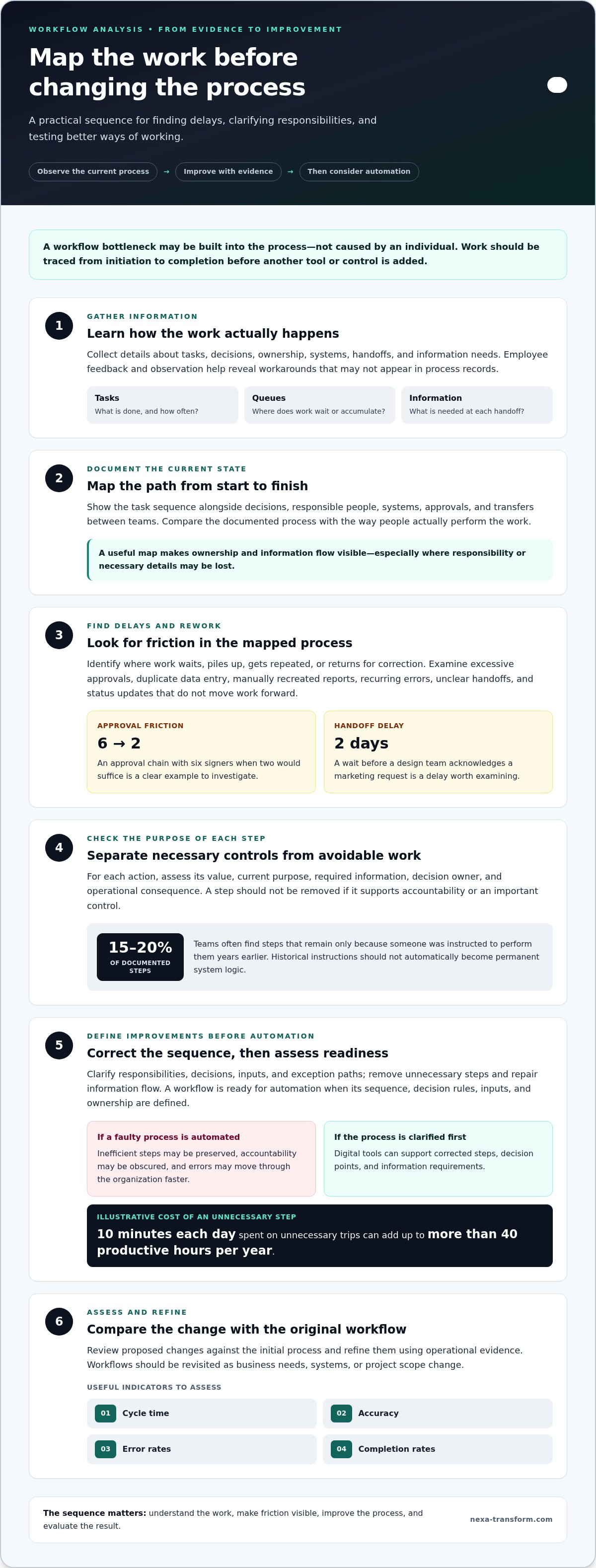
A workflow bottleneck is rarely just a slow employee; it may be built into the process itself. Workflow analysis consulting examines how work moves from initiation to completion, documenting ownership, decisions, systems, handoffs, delays, and rework. An approval chain with six signers when two would suffice is a clear example of friction to investigate.
Operational leaders often see work pile up between teams, information entered more than once, and time lost to status updates that do not move tasks forward. Adding software or another control is not automatically the answer. First, understand how the process works today, including where accountability or information is lost.
This article explains what workflow analysts do, how analysis can improve efficiency, and how to test and refine workflows over time. It also covers the difference between workflow and business process analysis, useful performance measures, and when automation may be appropriate after process issues have been identified.
Key Takeaways
- Map ownership, decisions, systems, and handoffs to locate where work stalls or is repeated.
- Correct unnecessary steps and unclear responsibilities before automating a process.
- Separate the task sequence of a workflow from the broader organizational outcome of a business process.
- Assess changes with indicators such as cycle time, accuracy, error rates, and completion rates.
- Review workflows regularly and adjust them as business needs, systems, or project scope change.
What does a workflow analyst do?
Trace work from initiation to completion, documenting tasks, decisions, ownership, systems, and handoffs. The resulting map helps reveal where delays, duplicated effort, or errors are built into operations.
Bottlenecks and Redundant Tasks
A bottleneck is a point where work waits, accumulates, or cannot proceed until a decision or resource becomes available. Identify its cause by comparing documented steps with what people actually do. Record potential inefficiencies such as excessive approvals, duplicate data entry, manually recreated reports, and recurring errors. For example, assess whether each signer contributes a necessary decision. This helps distinguish unnecessary steps from controls that support accountability.
Broken Handoffs and Workarounds
A broken handoff occurs when responsibility or necessary information is lost as work moves between people, teams, or systems. Examine each transfer for unclear ownership, missing instructions, or status updates handled through email. In a marketing design-request process, a two-day wait before the design team acknowledges receipt is a delay worth investigating. Separate trackers or copied information can also point to workarounds and gaps in the formal process.
To separate isolated delays from structural inefficiencies, task frequency, queue locations, and information needs can be examined. The National Institute of Standards and Technology study created workflow maps from aggregated office data to identify time-consuming tasks. Similar mapping can make hidden work visible, including repeated checks and activities performed outside documented procedures.
When selecting workflow analysis consulting in South Africa, look for a clear approach to documenting the current process, incorporating employee feedback, and tracing work end to end. Findings should link specific bottlenecks to practical changes in ownership, decisions, or information flow.
Workflow analysis typically starts with gathering information, then documenting the current process, identifying delays and rework, and defining improvement opportunities. Assess proposed changes against the original workflow and refine them using operational evidence.
Engagement length depends on the process scope, the teams and systems involved, and access to reliable workflow information. Reviewing one approval path requires less discovery than analysing workflows across departments and decision chains.
Risks include incomplete process records, overlooked workarounds, and employee concerns about how findings will be used. In a complex enterprise project, analyse risks during the initial phase so dependencies, data gaps, and potential delays can be considered early.
Operational efficiency and automation
Automation can increase throughput, but examine and improve the process first. Automating a faulty sequence may simply move errors through the organization faster.
Risks of Automating Broken Processes
Automating a broken process can encode inefficient steps before their purpose and value have been assessed. Unnecessary work may be preserved, accountability obscured, and later corrections made more difficult.
Consider a clerk making unnecessary trips that take 10 minutes each day. More than 40 productive hours per year can be lost this way. If the request or recording step is automated without removing the unnecessary trip, the underlying loss remains. Before implementation, each action should be assessed for value, required controls, and potential elimination.
Documented processes should also be scrutinized before configuration begins. Teams often find that 15-20% of documented workflow steps exist only because someone was instructed to perform them years earlier. Each step should be assessed against its current purpose, required information, decision owner, and operational consequence. Historical instructions should not be encoded as permanent system logic by default.
Preparing Workflows for Automation
A workflow is ready for automation when its sequence, decision rules, inputs, and ownership are defined. This preparation matters because both conventional automation and AI-enabled tools rely on usable process information.
The U.S. Bureau of Labor Statistics describes workflow analysis as beginning with information gathering and organizing information around problems or procedures. For automation readiness, collect details such as data fields, approval conditions, exception paths, and responsibility for incomplete records. If a form accepts inconsistent entries, those inconsistencies may carry through to later database tasks.
Evaluate task automation and database changes separately. A repetitive task can be automated without changing the underlying data structure. A database change, by contrast, can affect how information is stored, validated, retrieved, and passed between systems. Before implementation, document required records, error handling, and responsibility for data quality.
AI readiness calls for the same operational discipline. Inputs should be sufficiently consistent, outputs should have a defined business use, and exceptions should have an assigned review path. Do not treat missing process rules or unclear data ownership as problems an AI tool can solve on its own. Pilot a bounded task, compare its output with the required result, and refine the workflow before expanding its scope.
Once the process has been clarified, workflow automation and digital forms can support its execution. The design should reflect corrected steps, decision points, and information requirements, rather than transferring avoidable complexity into digital form.
Workflow analysis versus business process analysis
A business process defines a broader organizational objective, while a workflow maps the tasks, decisions, approvals, and information exchanges that support it. This distinction matters when an improvement initiative needs to address local delays without losing sight of the end-to-end result.
Bottlenecks and Resource Utilization
A workflow bottleneck is a constraint that slows work within a broader business process. Its effects can show up in resource use: one team may wait for approvals while another faces an uneven workload. For example, reviewing purchasing from request to payment can reveal whether delays stem from staff capacity, decision ownership, or a system dependency. End-to-end analysis helps avoid shifting work between departments without improving the result.
Employee involvement helps distinguish documented procedures from day-to-day practice. Review a process map with the people who perform each task, then compare it with their feedback about exceptions, duplicated work, and informal approvals. For example, a customer-service representative may enter a case in one system and re-enter the same information elsewhere. Their input can reveal avoidable work and help ensure improvements reflect real operating conditions.
Leaders need visibility into workflow status, not just informal updates. A shared view of decision points, owners, pending work, and completion status makes dependencies visible across departments. For example, when a customer response is delayed, leaders can see whether the queue sits with intake, approval, or fulfilment. Align performance measures with leadership’s evaluation criteria so reports reflect the operational outcomes used to guide decisions.
Documentation and Analysis Methods
Confluence process documentation provides a written reference for workflow steps, responsibilities, decisions, and exceptions. When a team records an approval path there, employees can refer to one shared process instead of separate instructions. Use documentation as a starting point for analysis, then compare it with actual work and employee feedback: a published procedure may omit workarounds or handoffs that occur in practice.
Workflow analysis methods combine process mapping with structured diagnosis. BPMN 2.0 can represent tasks, events, gateways, and handoffs; 5S can organize work areas and reduce process friction. DMAIC provides a framework for defining, measuring, analyzing, improving, and controlling a process. Ishikawa (Fishbone 6M) and 5-Why methods can help trace a recurring defect to contributing causes.
The method should match the decision being made. A BPMN 2.0 map can clarify cross-team sequence, while DMAIC can structure an improvement initiative around measured performance. Employee review, process documentation, and root-cause methods then connect the map to operational evidence. Together, these tools help leaders assess resource use, workload distribution, departmental collaboration, and customer response times without optimizing one team at another’s expense.
Testing and continuously improving workflows
Test a revised workflow against the operating conditions it is intended to improve. The current process provides a baseline; after changes, use the same performance indicators to see whether delays, errors, or completion rates have shifted.
Choose measures that match the process objective. For an approval workflow, track approval duration and completion rate; for data processing, monitor accuracy and error rates. Employee productivity, customer satisfaction, operating costs, and cycle time can also show whether an improvement has shifted effort elsewhere. Assign a process team member to record results and flag adverse changes.
Test both routine cases and exceptions. For example, check a revised customer-request process with complete submissions, missing information, and requests that require an additional decision. Each scenario shows whether instructions, ownership, and decision points remain clear under different conditions. Compare results with the original process rather than judging success solely by whether the new sequence can be completed.
Build contingency plans around known dependencies. If a vendor issue creates a high risk of delay, include buffer time in the project workflow. Give the affected handoff a clear owner and define the response path. This makes delays visible and helps departments coordinate without informal updates or duplicated status requests.
Continuous improvement needs both scheduled reviews and adjustments when circumstances change. Review a workflow thoroughly once a year and briefly every quarter. These checks can uncover changed systems, shifting leadership priorities, or new workarounds that have weakened the original design. For example, a quarterly review of purchasing may reveal that a new approval condition has lengthened processing time.
Let results guide the next change. If cycle time improves but accuracy falls, streamlining may have removed a necessary validation step. If customer satisfaction remains unchanged despite faster completion, the process may be improving an internal measure rather than the customer-facing outcome. Reviewing several indicators reduces the risk of optimizing one department while adding work elsewhere.
Adjust project workflows when scope or scale changes. A process designed for a small internal initiative may need different ownership and decision points as more departments become involved. Test the revised sequence with affected team members to uncover new dependencies before adopting the change across the organization.
Regular workflow analysis makes performance review an ongoing operating capability. Compare measures, document exceptions, and adjust the process as conditions change to preserve improvements and respond when a workflow starts to deteriorate.
Workflow analysis definition and purpose
Workflow analysis examines how tasks, decisions, and information move through an operation. It can cover a single function, such as processing a purchase request, or connected activities across departments. The aim is to understand how work is performed, where performance is constrained, and which changes could improve efficiency, cost-effectiveness, or control.
A defined scope sets the boundaries of the analysis. For a purchase request, it might begin when an employee submits a need and end when the request is approved and recorded. Identify the inputs, outputs, responsible roles, systems, decisions, and exceptions. This prevents a review from focusing on one task while missing a dependency that affects the full workflow.
Analysis also distinguishes documented procedures from actual work. An approval process may require a form, a review, and a recorded decision, while employees use email to resolve missing information. Documenting both paths shows where formal workflow and operational practice diverge. The difference may point to unclear instructions, overlapping responsibilities, or a control that is not working as intended.
Clear responsibilities and decision points support governance. They establish who owns each action, what information is required, and how incomplete submissions are handled. For example, a form can validate required fields before a request reaches an approver. This can reduce manual errors and make records more consistent across similar requests.
Workflow analysis can also support compliance and audit readiness by standardizing approvals, improving records, and validating required information. In customer onboarding, each defined review can be linked to its decision, owner, and supporting documentation. This makes missing records easier to identify and gives leadership a more reliable view than informal status updates.
After changes, update the workflow to reflect current responsibilities, decision rules, and system use. A process map that still shows an obsolete approval can send employees in the wrong direction. Make controlled updates and review them with affected teams to keep operational guidance aligned with practice and performance measures.
Workflow analysis consulting can help when teams need a structured diagnosis, documented process changes, or root-cause investigation. Where recurring defects or unclear process controls are limiting performance, a defined analysis can establish the operating problem before solutions are selected. For revised workflows that depend on consistent information capture, use workflow automation and digital forms to support the documented process.
Nexa Transform Group: Website Designing & Hosting
Nexa Transform Group supports organizations in turning workflow findings into defined process improvements. Business Process Management (BPM) helps align ownership, decisions, and process controls. For repetitive tasks ready for digitization, Workflow Automation & Digital Forms can support consistent information capture and execution. Custom Digital Systems can address requirements that call for a tailored digital solution.
Website Designing & Hosting can support workflows that depend on an organization’s website. The right next step depends on the operational issue and the changes needed to address it. Contact Nexa Transform Group to discuss your process requirements and potential next steps.
Put the Next Process Improvement Into Motion
Operational change is more likely to last when responsibility for the next decision is clear. Assign an owner to the improvement, define the intended result, and make the updated process part of routine management. This gives the organization a practical basis for responding as operating conditions change.
Workflow analysis consulting can turn process findings into structured improvements. Nexa Transform Group offers Business Process Management (BPM) and Workflow Automation & Digital Forms to support organizations implementing process changes. Website Designing & Hosting can also help when an organization’s website needs to support its operations.
Set the next step around the problem your organization needs to resolve, whether that means aligning process ownership, capturing information consistently, or updating a website that supports the workflow. Contact Nexa Transform Group to discuss the operational change you want to advance.
With a clear direction and an assigned owner, improvement can move from analysis to execution.
Frequently Asked Questions
How does fixing workflows affect team morale?
Improving workflows can reduce avoidable frustration when employees help identify the causes of delays and rework. For example, a team that repeatedly enters the same customer details can help assess whether the duplicate task is necessary. Clear ownership also reduces uncertainty about who must act next. Because morale depends on how changes affect workload and autonomy, consider employee feedback after implementation.
How much is the service?
The price depends on the case and is provided after a quote request. Scope depends on the number of processes involved, the teams and systems affected, the level of analysis required, and whether recommendations need to be implemented. Documenting an existing process differs from work that also includes redesign or digital implementation. These factors determine the work required and the resulting quote.
What are the 5 stages of a workflow?
A practical five-stage workflow can be described as initiation, information gathering, review or decision, execution, and completion. In a purchase request, an employee submits the need, supporting details are collected, an approver reviews it, the purchase is carried out, and the outcome is recorded. Stages vary by process. Defining entry and exit conditions helps teams distinguish a completed workflow from one awaiting action.
What is workflow analysis consulting?
Workflow analysis consulting provides professional support to examine how work is performed and identify where process changes may help. It can include documenting tasks, decision rules, roles, and system interactions, then assessing performance and possible causes of delays. For example, a consultant might review how service requests move from intake to resolution. The goal is to provide an evidence-based foundation for process improvement.
What services do workflow analysis consultants provide?
Services can include documenting current processes, interviewing employees, mapping workflows, assessing bottlenecks, analysing root causes, and recommending improvements. Some engagements also support redesign or implementation through business process management and workflow automation. Match the scope to the operational problem: clarifying responsibilities calls for different work from preparing a repetitive process for digital forms or custom systems.
How much does workflow analysis consulting cost in the United States?
The price depends on the case and is provided after a quote request. In South Africa, relevant cost factors include the number and complexity of workflows, the departments and systems involved, the available data, and whether implementation support is required. A narrowly scoped diagnostic differs from a cross-functional transformation. These factors shape the work and the resulting quote rather than a single universal rate.
How do you measure workflow analysis results and ROI?
Measure results by comparing operational indicators before and after a change, using consistent definitions and scope. For example, track request processing time, correction frequency, and completed cases for the same type of work. To estimate ROI, compare quantified benefits, such as reduced rework or operating effort, with implementation and ongoing costs. Record assumptions and leave out benefits that cannot be attributed to the workflow change.
How does workflow analysis consulting compare with business process consulting?
Workflow analysis consulting focuses on the sequence of activities that moves a task or transaction forward. Business process consulting typically considers the broader organizational outcome, including how related workflows, roles, and controls support it. For example, a workflow review might examine invoice approval, while a broader engagement could assess the full purchasing function. The appropriate scope depends on whether the issue is localized or spans the operating model.


