

The right business process management consulting engagement starts with a defined operational problem, not a standard fee or an impressive résumé. It can help when recurring delays, inconsistent handoffs, avoidable errors, or outdated workflows are getting in the way of business goals. Cost depends on the scope of analysis, implementation needs, systems involved, and expertise required.
A useful engagement should do more than document existing work. It should identify process friction, recommend practical changes, support implementation, and define how progress will be assessed. This article explains how processes are analyzed, what affects consulting costs and value, how to evaluate a consultant’s experience and approach, and how to assess implementation and results.
Key Takeaways
- Identify where delays, rework, inconsistent handoffs, or unnecessary decisions are weakening operational performance.
- Use process maps and performance data to distinguish root causes from symptoms and prioritize improvement opportunities.
- Assess a consultant’s relevant experience, analytical approach, implementation capability, and evidence of results.
- Define the current and desired process states, then track outcomes such as cycle time, error rates, throughput, and customer satisfaction.
- Evaluate project value against its scope, systems involved, implementation needs, and the measures used to judge impact.
How Do Different Industries Benefit from Process Consulting Services?
Business process management consulting identifies, documents, analyzes, redesigns, implements, and monitors an organization’s processes. Unlike business process outsourcing, consulting improves processes while the organization retains responsibility for carrying them out. Outsourcing transfers process work to an external provider.
The right operational improvements depend on the industry and the process. In manufacturing, tracing a production order from release through inspection can expose duplicate approvals or delayed material handoffs. In customer service, mapping a case from intake to resolution may reveal repeated data entry or unclear escalation decisions. In financial operations, documenting a month-end close can clarify task ownership and reduce avoidable handoff delays. These examples show how process redesign can remove non-value-adding steps, simplify decisions, standardize variable work, or resequence activities. The best intervention depends on the process, its constraints, and the intended business outcome.
Business consulting and process consulting address related but distinct needs. Business consulting may shape a growth strategy, market approach, or customer interaction model. Process consulting turns operational priorities into defined workflows, responsibilities, decision points, and performance measures. For example, after a company sets an expansion strategy, its order-management process may need clearer ownership and consistent procedures across teams. This connects strategic intent to daily execution, rather than treating process redesign as an isolated efficiency exercise.
Method selection should follow the problem being addressed. Lean focuses on identifying waste and improving flow; Six Sigma supports structured analysis of variation and defects; Kaizen emphasizes ongoing, incremental improvement. DMAIC provides a staged approach: define the problem, measure current performance, analyze causes, improve the process, and control the revised method. Root-cause tools such as an Ishikawa diagram or 5-Why analysis can help distinguish a recurring cause from a visible symptom. The methods can be combined, but the process evidence should determine which tools are useful.
Sustained improvement depends on operational ownership, feedback, and review. After a revised service workflow is introduced, a process owner can monitor turnaround time, error rates, and unresolved cases. Frontline feedback may uncover workarounds missed during initial mapping. Lean reviews or Kaizen sessions can test targeted adjustments, while documented procedures support consistency. Technology can automate repetitive tasks, but first clarify the workflow’s rules, exceptions, and handoffs. This sequence helps prevent existing process defects from being built into new systems.
Process analysis and opportunity identification
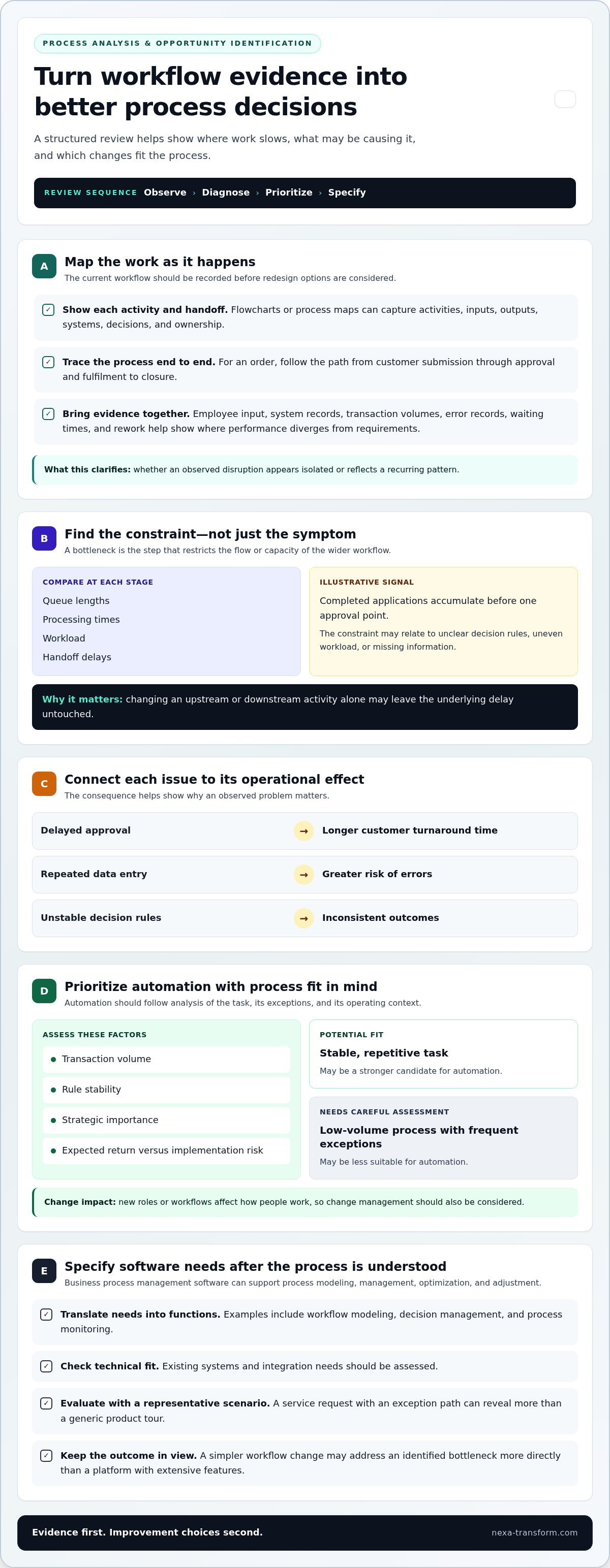
Identify process opportunities by comparing actual workflow performance with operational requirements. Use process maps, employee input, system records, and performance data together.
Process Analysis and Data Collection
Process analysis records how work moves between people, systems, decisions, and handoffs. Flowcharts or process-mapping software can show each activity, its inputs and outputs, and who owns it. For example, trace an order from customer submission through approval and fulfilment to closure. Transaction volumes, error records, waiting times, and rework indicate where performance diverges from expectations. This evidence helps distinguish a one-off disruption from a recurring pattern and gives improvement work a factual starting point.
Bottleneck Identification
A bottleneck is a step that restricts the flow or capacity of an entire workflow. Compare queue lengths, processing times, workload, and handoff delays at each stage to find one. For example, if completed applications build up before a single approval point, that stage may be limiting throughput. The cause could be unclear decision rules, uneven workload, or missing information. Identifying the constraint matters: changing an upstream or downstream activity alone may leave the underlying delay untouched.
Link each observed problem to its operational consequence. A delayed approval may lengthen customer turnaround time; repeated data entry can increase the risk of errors; unstable decision rules may produce inconsistent outcomes. Assess automation opportunities by considering transaction volume, rule stability, strategic importance, and expected return relative to implementation risk. A stable, repetitive task may be a better candidate than a low-volume process with frequent exceptions. Also consider change management, since new roles or workflows affect how people work.
Business process management software (BPMS) provides platforms for modeling, managing, optimizing, and adjusting processes. Select software after analyzing the process, not before. Translate requirements into functional needs, such as workflow modeling, decision management, or process monitoring, and assess technical fit with existing systems. Use representative scenarios in demonstrations, such as routing a service request with an exception path, rather than relying on generic product tours. Customer interviews and a formal request-for-proposal or interview process can help compare platforms consistently.
Keep the evaluation tied to the intended process outcome. A platform may offer extensive features, yet a simpler workflow change may address the identified bottleneck more directly. Internal leaders should align on requirements, ownership, integration needs, and adoption impacts before a decision is made. For an operational review that connects process analysis with practical redesign, Business Process Management support can help structure the work around documented workflows and improvement priorities.
Selecting a consultant or consulting firm
Choose a suitable consultant by matching their experience and methods to the process problem. Establish how internal leaders will participate and how success will be assessed.
Consultant Selection Criteria
Consultant selection criteria are the capabilities and evidence used to assess a candidate’s fit. Relevant industry experience matters because process constraints vary across sectors, from production controls to customer case handling. Look for examples of comparable work and clearly explained outcomes. For instance, a firm addressing recurring service delays should be able to describe how it diagnosed handoffs, involved process owners, and assessed the changes.
BPM Consulting Partner Selection
A BPM consulting partner should provide analysis and implementation support that fits the organization’s operating needs. Before evaluating candidates, internal leaders should agree on process scope, technical requirements, and decision authority. This helps avoid choosing services that address a different problem. For example, a team seeking workflow redesign should distinguish that need from a broader organizational restructuring mandate.
Assess technical and functional fit against actual use cases, not general capability claims. Ask for a demonstration of a representative workflow, including routine decisions and exception paths. Stakeholder interviews can test whether the proposed approach meets frontline and management needs. A formal request for proposal or structured interview process makes responses easier to compare. Apply the same criteria to each candidate, including how they document current operations, define a future state, and support adoption.
- Industry relevance: Look for experience with similar process conditions and operational constraints.
- Method fit: Assess whether the proposed analysis matches the problem and available evidence.
- Implementation capability: Establish how roles, systems, and employee support will be addressed.
- Results evidence: Review examples that connect process changes to defined performance measures.
Match the scope to the organization’s actual need. A business with flat revenue and systems that are not under strain may need a focused project consultant rather than fractional COO support. Broader leadership or change-management challenges may call for wider organizational involvement. Cost depends on project scope, process complexity, technical requirements, and implementation support. Tie these factors to clear deliverables, such as mapped workflows, prioritized improvements, and agreed measures, so the engagement can be judged by operational value rather than activity alone.
Assessment, implementation, and monitoring steps
A BPM initiative should connect a documented current state to a defined future state. Stage, assign, and monitor implementation against operational goals.
Implementation Pitfalls
Implementation pitfalls are conditions that prevent a redesigned process from being adopted or sustained. Resistance to change, weak stakeholder buy-in, and process complexity can disrupt work even when the proposed workflow is sound. For example, a new approval route may fail if employees are not involved early or decision ownership is unclear. Early communication, practical training, and a controlled rollout help manage these risks.
Keep the scope proportionate to the process being changed. A complex organization-wide redesign can delay learning when a smaller pilot could reveal handoff or role problems sooner. A service team might test revised case routing in one workflow, gather employee feedback, and adjust exception handling before expanding it. Changes can then be scaled gradually, with documentation updated as responsibilities and process steps evolve.
BPMS Implementation and Support
BPMS implementation configures process technology around approved workflows, roles, rules, and system connections. Software can formalize a process, but it cannot resolve unclear decisions on its own. Before deployment, process owners should confirm inputs, outputs, decision points, and exception paths. Coordinate training, updated documentation, and technology integration so employees can complete activities consistently when the new workflow is introduced.
Modeling tools can simulate proposed changes before implementation. For example, a team can model how a revised service-request process handles incomplete submissions, approvals, and escalations. Stakeholders can review the design and identify gaps before live work is affected. During rollout, gather feedback from process users and assign ownership for resolving defects and maintaining the workflow as requirements change.
Measuring Improvement and ROI
BPM consultants measure improvement by comparing process indicators with the baseline and agreed future-state targets. Cycle time, error rate, and throughput show whether execution has changed; turnaround time, cost, and customer satisfaction connect those changes to business goals. Assess ROI by comparing the value of observed gains with the resources required for analysis, implementation, training, and ongoing support.
Match measures to the process objective. If a revised fulfilment workflow is intended to reduce delays, throughput alone may not be enough: also review turnaround time and error rates. If a service process is meant to improve customer experience, interpret satisfaction measures alongside handling time and rework. This avoids calling a process successful simply because it is faster when defects or customer friction have increased.
Monitoring should continue after implementation, not stop at launch. A named process owner can review performance indicators, employee feedback, and exceptions, then record corrective actions. Balance improvement priorities against expected return and risk. If evidence shows that a change has weakened another outcome, adjust and document the process, then reassess it using the same measures.
Case studies, references, cost, and experience
Evidence of past work can indicate whether a consultant is suited to the process problem. Assess cost and expertise against scope, implementation needs, and intended outcomes.
Case Studies and References
A case study describes a process challenge, the intervention, and the results measured. A relevant example shows how an approach was applied in practice. For instance, a customer-service case should explain how delays were assessed, what workflow changes were made, and which measures were tracked afterward.
Examine references and case studies in context, not just for outcome claims. A financial-close example may involve different systems and controls from order fulfilment. Compare the process complexity, stakeholder involvement, and implementation requirements with your own situation. Then assess whether the reported results were linked to measures such as turnaround time, error rate, or throughput.
Consulting Cost and Experience
Consulting cost depends on the engagement’s scope, process complexity, technical requirements, and implementation support. The price depends on the case and is provided after a quote request; the work required and systems involved shape the scope. A diagnostic review differs from a redesign that also involves technology integration, training, and monitoring.
Experience should be matched to the assignment rather than judged by tenure alone. Business Process Consultants have an average of 3-4 years of experience. For a complex workflow, also consider demonstrated skills in project management, data analysis, and process improvement. A consultant’s ability to connect those skills to your specific process is more informative than a general claim of expertise.
Expertise and External Perspective
Consultant expertise combines analytical, communication, and problem-solving skills with practical process knowledge. An external perspective can help reveal assumptions embedded in internal routines. For example, a consultant reviewing a claims workflow may spot repeated data entry that employees accept as necessary, then trace it to disconnected steps or unclear input requirements.
Strong analysis should lead to a practical framework for optimization. A consultant can use DMAIC to structure problem definition, measurement, analysis, improvement, and control. Ground innovation in process evidence, such as frontline feedback or a tested workflow change, rather than adopting technology for its own sake. Keep internal process owners involved so the organization retains knowledge and accountability.
To assess process constraints and define a practical improvement approach, request a process improvement discussion.
Nexa Transform Group: Website Designing & Hosting
Nexa Transform Group supports organizations that need to turn process improvements into practical digital systems. Its Business Process Management (BPM) work can document workflows, identify operational friction, and shape improvements around business requirements.
When repetitive steps or paper-based handoffs constrain execution, Workflow Automation & Digital Forms can structure information capture and routing. If existing tools do not fit the process, Custom Digital Systems can be developed to support the required workflow. Website Designing & Hosting is relevant when a business website also needs to support digital operations.
These services are most relevant when process analysis identifies a clear need for workflow redesign, automation, or a tailored system. Contact Nexa Transform Group to discuss your process requirements.
Turn process findings into an accountable next step
Operational improvements last when ownership, decision rights, and review routines become part of everyday work. Before launching a change, define who will maintain the process, how exceptions will be handled, and which outcomes will guide future adjustments. This governance makes business process management consulting a repeatable management capability rather than a one-time intervention.
The next step is to connect your priority process with an implementation path suited to your organization’s systems and operating model. Nexa Transform Group can help translate process requirements into practical digital solutions. Contact Nexa Transform Group to discuss the work ahead and establish a clear starting point.
Frequently Asked Questions
Who should you hire?
Engage a BPM consultant when a defined process problem needs diagnosis and redesign. A consulting firm may be appropriate when broader specialist or implementation capacity is needed. For example, focused expertise may be enough for recurring invoice-routing delays, while connected workflow changes across departments may need coordinated support. Match the choice to the scope, technical demands, and internal capacity to carry changes forward.
How do BPM and RPA tools fit together?
BPM coordinates end-to-end processes across people, data, and applications; robotic process automation (RPA) handles repetitive manual tasks. For example, BPM can govern an order’s movement through review and fulfilment, while RPA can automate recurring information transfers. RPA can also support connections with systems that lack APIs. Align task automation with a defined process instead of using it to preserve unnecessary steps.
What areas does BPM address?
BPM organizes work across process steps, roles, information, and technology. It can address customer interactions, internal approvals, supply-chain activity, project delivery, and financial operations. For example, a hospital can examine how appointment information moves between intake and scheduling teams. This approach manages the full flow, including handoffs and decisions, rather than optimizing one isolated task at the expense of connected activities.
What are the benefits of hiring a BPM consulting firm?
Business process management consulting can provide structured analysis, specialist methods, and implementation capacity when these are not available internally. An external perspective can also challenge assumptions embedded in routine work. For example, comparing written procedures with employee practices may reveal a gap that needs clarification. Include knowledge transfer so process owners can maintain revised workflows after the engagement ends.
How much does business process management consulting cost in the United States?
Costs depend on the engagement, not on a universal rate. The price depends on the case and is provided after a quote request; process complexity, scope, systems involved, and implementation support shape the work. A documentation review differs from a project involving redesign, system integration, training, and performance monitoring. Assess the budget against defined deliverables and project boundaries.
How do BPM consulting firms price their services?
Fees are generally structured around the work and delivery model. A defined project may be scoped around agreed outputs, while ongoing support may be organized as a continuing engagement. Complexity, specialist expertise, stakeholder involvement, technology requirements, and implementation responsibilities affect the effort involved. Compare proposals by the analysis, workshops, documentation, change support, and post-launch monitoring included, rather than by fee labels alone.
How do you choose a business process management consultant?
Choose a consultant whose experience and method match the process challenge. Review relevant examples to understand how problems were diagnosed, which stakeholders were involved, and how outcomes were evaluated. Discuss an actual workflow to assess communication and analytical capability. For technical projects, consider whether system constraints and functional needs are understood. A strong fit is demonstrated through reasoning grounded in the operating context.
What are the steps in a business process management consulting engagement?
An engagement typically moves from scope definition to current-state analysis, future-state design, implementation, and monitoring. First, agree on the process and intended outcome. Then review workflows and performance evidence, and work with stakeholders to shape the revised process, roles, and measures. Include relevant training and documentation in implementation. After launch, review performance and make adjustments, such as refining a service team’s routing approach in response to handoff delays.


